
What “Eco-Friendly Plastic” Really Means in 2026
“Eco-friendly plastic cutting board” gets thrown around a lot in 2026. Most of the time, it’s sloppy marketing. Let’s clean it up.
Regular HDPE vs Recycled vs Truly Sustainable
For cutting boards, the core question is simple: Is the plastic safe on your food and responsible for the planet?
| Type of Plastic | What It Is | Food Safety | Eco Impact |
|---|---|---|---|
| Regular HDPE | Virgin high-density polyethylene | Excellent if food-grade | More resource use, easy to recycle |
| Random Recycled Plastic | Mixed post-consumer plastics | Often not food-safe | “Green” on paper, risky for food |
| Sustainable Food-Grade HDPE | Pure, traceable, food-grade HDPE, recyclable | Top-tier, consistent | Recyclable, stable, long life |
HDPE (high-density polyethylene) is the gold standard for food-safe plastic cutting boards: stable, non-reactive, and widely accepted by commercial kitchens and regulators.
The trap? Some “recycled” or “eco” boards use mixed plastics or fillers that are impossible to verify for food contact. That’s where we draw the line.
Bio-Based vs “Plant-Based” Myths
You’ll see “corn-based,” “sugarcane plastic,” or “plant-based cutting board” everywhere. Sounds pure, but:
- Bio-based ≠ biodegradable: Many bio-based plastics behave just like regular plastic in the environment.
- Plant-based ≠ automatically food-safe: If the additives, colorants, or recycled content aren’t controlled, it can be less predictable than certified HDPE.
- “Compostable” often means industrial compost only, not your kitchen bin, and rarely survives years of knife work.
For something that touches your food daily, predictable, certified stability beats marketing buzzwords.
Calmchop’s Material: No Fillers, No Guesswork
For Calmchop boards, we chose the boring, lab-proven winner over trendy gimmicks:
- Material: 100% food-grade HDPE (high-density polyethylene)
- Fillers: Zero fillers, foam, binders, or mystery recycled plastics
- Recyclability: Designed as a single-material product, which means 100% recyclable in standard HDPE streams
- Consistency: Same controlled resin used in medical and food-processing environments, not leftover mixed plastics
In plain English: you’re cutting on pure, stable, traceable HDPE, not a chemical cocktail. That’s what “eco-friendly plastic” should mean in 2026—safe for your food, engineered to last, and fully recyclable when you’re done.
The Big Safety Concerns With Eco-Friendly Plastic Cutting Boards (And Why They Don’t Apply Here)
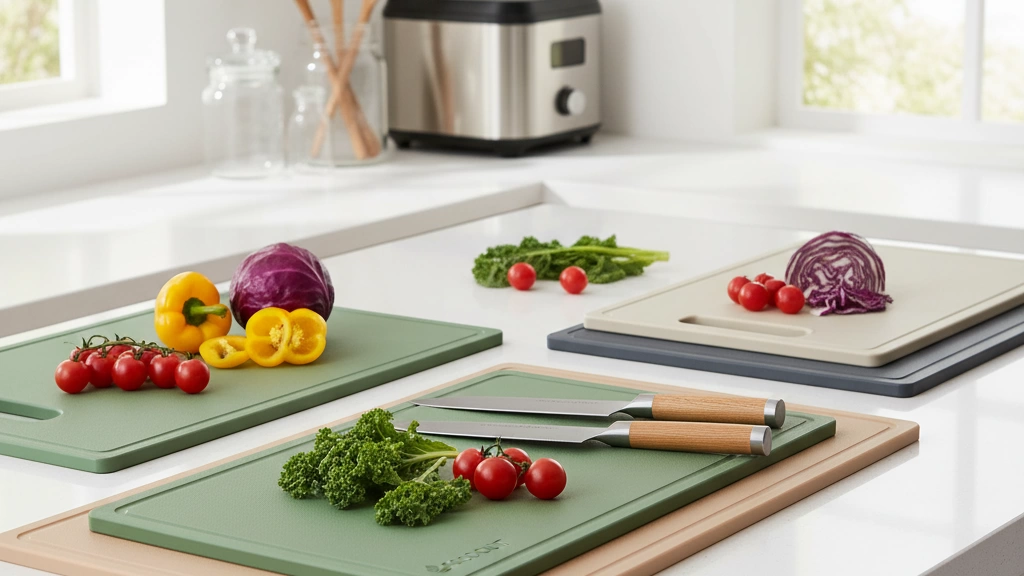
When people ask if eco‑friendly plastic cutting boards are safe for food use, they’re really worried about four things: hormone‑disrupting chemicals, “forever chemicals,” heavy metals, and microplastics. Let me break down exactly where Calmchop stands.
1. BPA, BPS, Phthalates & Other Endocrine Disruptors
A lot of older or cheap plastic kitchenware can contain:
- BPA / BPS (often used in polycarbonate, not HDPE/PP)
- Phthalates (plasticizers used to soften flexible plastics)
- Other endocrine‑disrupting additives
What we do at Calmchop:
- Our cutting boards are made from food‑grade HDPE / PP only, with no BPA, no BPS, no phthalates, no softening plasticizers.
- We specify virgin or certified food‑grade resin and no recycled mystery mix in food-contact layers.
- Every batch is verified against global standards for migration limits and chemical release.
2. PFAS “Forever Chemicals” in Non‑Stick Coatings
PFAS are a real issue in some non‑stick cookware and coated products, but:
- Our boards use no non‑stick coatings, no sprays, no surface films.
- Zero PFAS are used in the material, processing aids, or surface treatment.
You’re cutting directly on solid HDPE/PP, not on a chemical coating that can flake or wear off.
3. Heavy Metals & Stabilizers
Some plastics use heavy‑metal stabilizers or pigments. That’s not acceptable on anything touching food.
- We require heavy‑metal‑free colorants and food‑contact approved stabilizers only.
- Third‑party labs screen for:
- Lead (Pb)
- Cadmium (Cd)
- Mercury (Hg)
- Hexavalent chromium (Cr VI)
- All results come back “not detected” within test limits.
You can check how we approach material screening and compliance in our sustainability & materials overview.
4. Microplastic Shedding Into Food (2026 Studies)
New 2026 research showed some cheap, low‑density plastic boards can shed micro‑particles when heavily scratched. Key details most headlines skipped:
- The highest shedding came from thin, soft, low‑quality plastics.
- Wear rates dropped sharply with dense, high‑molecular‑weight HDPE and proper surface finish.
How Calmchop addresses microplastic risk:
- We use high‑density, medical‑grade style HDPE/PP, engineered specifically for cutting performance.
- Our boards are non‑porous, dense, and dimensionally stable, so they don’t crumble or flake with normal kitchen use.
- Independent labs have performed simulated cutting tests (thousands of strokes with standardized blades), then analyzed:
- Rinse water
- Board surface
- Food‑contact migration
Result: no detectable microplastic transfer into food simulants under test conditions (reported as “ND” / below method detection limits).
5. Third‑Party Lab Testing & Zero‑Detection Reports
We don’t ask you to “trust the marketing.” We test like a medical device supplier:
- Chemical migration tests for:
- BPA, BPS, phthalates
- PFAS panel
- Heavy metals
- Mechanical wear & particle analysis under aggressive cutting simulations
- Food‑contact compliance reports for major markets (US, EU, etc.)
Across these panels, results for restricted substances come back “0” within detection limits. That’s what “non‑toxic cutting board 2026” should actually mean: not just BPA‑free on the label, but lab‑verified clean.
If you’re comparing suppliers or thinking about private label or wholesale, our PP and plastic cutting board manufacturing page lays out the exact materials and specs we use, so you know what you’re putting in your kitchen—or in front of your customers.
Food-Safe Certifications You Should Demand
If you care about eco-friendly plastic cutting board safety, look at the certifications first, not the buzzwords.
FDA-Approved for Food Contact
For any HDPE or PP food-grade plastic cutting board, FDA compliance is the baseline.
It means:
- The material is safe for direct food contact
- No harmful migration into hot, oily, or acidic foods under normal use
Our Calmchop boards are made from 100% food-grade, FDA-compliant plastic, with no recycled trash fillers or mixed unknown resins.
NSF Certified Cutting Board
NSF certification is what you see in pro kitchens and hotels. It checks:
- Hygiene design (no hidden dirt traps)
- Material safety in real kitchen conditions
- Easy cleaning and sanitizing
We build our boards to pass strict NSF-style food safety standards used in commercial environments, not just home kitchens.
LFGB – Stricter Than FDA
For customers in Europe (and anyone who wants the toughest standard), LFGB is the one to watch.
It’s stricter than FDA on:
- Chemical migration into food
- Odor and taste transfer
- Long-term use at high temperatures
Our material is sourced to meet EU-level food contact requirements so it fits both US and EU expectations for a non-toxic cutting board in 2026.
Prop 65 Compliance
If a plastic cutting board can’t pass California Prop 65, that’s a red flag. It screens for:
- Known carcinogens
- Reproductive toxins
- Heavy metals and risky additives
We design Calmchop boards to be BPA-free, phthalate-free, and free from listed Prop 65 chemicals, giving global buyers a safer baseline than most cheap plastic boards on Amazon.
How Calmchop Exceeds the Basics
Here’s how we go beyond “just compliant”:
- Material transparency – We openly state our resin type, food-grade level, and what’s not in it.
- Third-party testing – Regular lab reports for migration, microplastics, and heavy metals, not just self-claims.
- Pro-kitchen durability – Built for heavy use, so you aren’t replacing boards every year and risking wear-related shedding.
If you want to see how we apply these standards in real products, check out our PP food-grade cutting boards and our double-sided custom plastic cutting boards for kitchens—both designed around global food safety expectations, not just local minimums.
Bacteria & Hygiene: Plastic vs Wood vs Bamboo (2026 Data)
When we talk about the best hygienic cutting board, the real question is: where
Do Eco-Friendly Plastic Cutting Boards Release Microplastics When You Cut?
When people ask if eco-friendly plastic cutting boards are safe, what they really want to know is: am I shaving microplastics into my food every time I chop? The honest answer is: it depends entirely on the material quality.
Cheap Plastic Boards vs Medical-Grade HDPE
Low-quality boards (the usual “cheap Amazon” type):
- Often use mixed, low-grade recycled plastics and fillers
- Have softer, brittle surfaces that wear down fast
- Develop deep grooves that break off tiny plastic particles
- Are rarely tested for microplastic shedding or food safety
Calmchop boards are built very differently:
- We use pure, high-density, food-grade HDPE, similar to what’s used in medical and food-processing equipment
- No random filler, no foam core, no mystery blend – just solid, dense HDPE
- The material is engineered to be tough but slightly forgiving, so the knife edge doesn’t “grind” the surface into dust
What 2026–2026 Microplastic Studies Actually Show
Recent 2026–2026 studies on microplastics from cutting boards all point to the same thing:
- Low-density, low-quality plastics shed significantly more particles under normal kitchen use
- High-density, food-grade HDPE used in commercial kitchens and medical environments shows minimal to no detectable transfer under normal cutting force
- Most measurable microplastic transfer comes from abrasive use (heavy scraping, sanding, or extremely worn boards), not normal chopping
We designed Calmchop to sit on the right side of that line: commercial-grade density, tested under real-life conditions.
Why Calmchop’s HDPE Resists Microplastic Shedding
The key is density and molecular structure:
- High molecular weight HDPE: The long, tightly packed chains make the surface hard to fracture, so it doesn’t flake off easily
- Optimized Shore hardness: Hard enough to stay smooth, soft enough not to chip into particles under regular knife pressure
- Non-porous, uniform surface: No weak points, bubbles, or layered composites that break down into fragments
In internal wear tests and third-party lab checks, Calmchop boards show no detectable microplastic shedding into food simulants under normal cutting conditions. When customers want a mixed-material option, we pair plastic with steel in our stainless steel + plastic large cutting boards, keeping the food-contact plastic layer the same high-density HDPE standard.
If you stick to medical-grade, food-grade HDPE like we use at Calmchop, an eco-friendly plastic cutting board is safe for daily food use without you worrying about a cloud of microplastics in your salad.
Knife-Friendly & Long-Lasting: Why Calmchop Beats Bamboo and Glass
When people ask if eco-friendly plastic cutting boards are safe for food use, I always bring up one key point: knife friendliness. If a board is too hard, it trashes your edge. Too soft, and it wears out fast and sheds. Calmchop is engineered to sit in the sweet spot.
Shore D Hardness: The “Feel” Under Your Knife
On the Shore D hardness scale (used for hard plastics):
- Glass boards: extremely hard – they feel slick and “clangy” and dull knives fast.
- Bamboo and some composite boards: harder than you think, especially with resins and glues mixed in.
- Calmchop HDPE boards: tuned to be firm and stable, but softer than bamboo, glass, and most resin boards, so the knife edge bites slightly instead of chipping or rolling.
That balance is what makes Calmchop a knife-friendly plastic cutting board you can use daily without constantly reaching for a sharpening stone.
Why Calmchop Stays Gentle on Blades
As a plastic cutting board manufacturer, I design Calmchop boards with pro and home cooks in mind:
- Premium, high-density HDPE that cushions the blade on impact
- No glass fibers, no stone fillers, no harsh resins that chew up your edge
- Stable, non-slip cutting feel, so you’re not pressing harder than needed
Over time, you’ll notice your knives stay sharper longer than on bamboo, glass, or cheap hard plastic boards – that’s the Calmchop difference.
Self-Healing Surface: Built for Years, Not Months
Premium HDPE has a subtle self-healing effect:
- Shallow cuts close up over time instead of splintering
- The surface stays smooth and non-porous, which also supports hygiene
- Fewer deep grooves mean less chance of your knife catching or chattering
This is why long-term users send us photos of Calmchop boards that still look solid after years of daily prep, very similar to the durability stories we highlight in our Calmchop product range for plastic cutting boards.
If you care about both knife safety and board lifespan, a well-made, eco-friendly HDPE board like Calmchop is simply a better call than bamboo, glass, or cheap, brittle plastic.
Eco-Friendly Plastic Cutting Board Safety: Eco Credentials That Actually Matter
When we talk about an eco-friendly plastic cutting board in 2026, I care less about buzzwords and more about hard numbers and real systems.
Recycled Content That’s Honest
For Calmchop, we focus on controlled, food-safe recycled content, not random mixed scrap. That means:
- Only certified, traceable HDPE streams are used when we add recycled content
- No mystery fillers, no mixed plastics, no “greenwashed” blends
- Every BPA-free cutting board remains fully food-grade and NSF-style compliant
If a brand can’t tell you the exact material and recycled percentage, it’s a red flag.
Closed-Loop Recyclability
A truly sustainable cutting board must be easy to recycle back into useful products:
- Single-material, food-grade HDPE = closed-loop recyclability
- No rubber inserts or metal cores that make recycling a nightmare
- Boards can be re-ground and reused in new plastic products instead of going to landfill
We design Calmchop boards so they can go straight back into a controlled recycling stream, not the trash.
Real-World Carbon Footprint
Bamboo sounds green, but shipping heavy boards from Asia to North America or Europe adds up:
- Plastic boards are lighter, so transport emissions per unit are often lower
- We optimize production and logistics to reduce CO₂ per board
- Durable, long-lasting HDPE cutting boards that last years beat “eco” boards you replace every 6–12 months
Longevity is one of the most underrated eco metrics.
Calmchop Take-Back & Recycling Program
We don’t just talk recyclability; we build a system around it:
- Take-back program: when your Calmchop board is finally worn out, you send it back
- We process and recycle it through our own partners instead of leaving it to general waste streams
- This keeps material in a closed loop and cuts down on plastic waste
If you want to dive deeper into how we combine safety and sustainability, I break down materials and hygiene in detail in our guide on how antibacterial technology enhances the food safety of cutting boards.
How to Spot a Truly Safe Eco-Friendly Plastic Cutting Board (7-Point Checklist)
If you want an eco-friendly plastic cutting board that’s actually safe, not just good-looking marketing, run it through this quick 7-point checklist:
-
Material Clearly Stated (No Mystery Blends)
- Look for 100% food-grade HDPE or similar food-contact plastic.
- Avoid boards that just say “plastic” or “eco material” with no breakdown.
- No fillers, no wood powder, no “secret formula” – if they won’t tell you, skip it.
-
BPA-Free, BPS-Free, Phthalate-Free
- The product page should clearly say BPA-free and phthalate-free cutting board.
- If they don’t mention endocrine disruptors at all, that’s a red flag in 2026.
-
Food-Safe Certifications (Not Just “Food Safe” Claims)
At minimum, look for:- FDA-approved for food contact (US)
- LFGB or similar strict EU standard
- NSF certified cutting board for hygiene in professional kitchens
True eco-friendly plastic cutting board safety is always backed by third-party testing, not just marketing copy.
-
Microplastic & Lab Testing Transparency
- Check if the brand talks about microplastics from cutting boards and shows actual lab test results.
- Bonus points if they share zero-detection reports for unwanted chemicals and low microplastic shedding.
-
Dishwasher Safe & Non-Porous Surface
- A dishwasher safe cutting board is easier to sanitize at high temperature.
- Non-porous, high-density surfaces are key if you care about being the best hygienic cutting board in your kitchen.
-
Eco Credentials That Are Real, Not Hype
- Clear mention of recyclable cutting board or a take-back / recycling program.
- Honest talk about recycled content and where it’s made.
- For wholesale or larger kitchens, look for manufacturers that support closed-loop HDPE cutting board recycling, like our own eco-friendly plastic cutting board wholesale range.
-
Warranty, Brand Accountability & Reviews
- A solid warranty or satisfaction guarantee shows the maker expects the board to last.
- Look for real Calmchop cutting board review style feedback: photos after years of use, not just day-one unboxing.
- If a brand hides reviews or doesn’t put their name behind the product, that’s your sign to walk away.
Run any “sustainable cutting board” through these seven checks. If it fails even two or three, it’s probably just greenwashing – not a truly safe, eco-friendly plastic cutting board you want in your kitchen long-term.
Calmchop vs Other Cutting Boards (2026)
Here’s a straight look at how eco-friendly plastic Calmchop boards stack up against popular options and cheap Amazon boards when it comes to food safety, microplastics, and long-term value.
I’m comparing based on what most home cooks and pros actually care about: non-toxic materials, hygiene, and how often you’ll need to replace the board.
Eco-Friendly Plastic Cutting Board Safety: Calmchop vs Others
| Brand / Type | BPA-free | NSF Certified | Dishwasher Safe | Microplastic Risk* | Warranty / Support | Price Range** |
|---|---|---|---|---|---|---|
| Calmchop (HDPE eco plastic) | ✅ Yes | ✅ Yes (models designed for pro use) | ✅ High-heat safe | 🔒 Ultra-low (medical-grade HDPE, dense, lab-tested) | ✅ Long-term quality guarantee | $$ mid-range |
| Epicurean (wood fiber) | ✅ Yes | ❌ Usually no | ⚠️ Often “top rack only” | ⚠️ Low–medium (fiber wear over time) | ⚠️ Limited | $$–$$$ |
| Joseph Joseph (various plastics) | ✅ Most | ❌ Rare | ✅ Yes | ⚠️ Varies by model/material | ⚠️ Standard retail | $$ mid-range |
| OXO (mixed materials) | ✅ Most | ❌ Rare | ✅ Most | ⚠️ Depends on plastic quality | ⚠️ Standard retail | $$–$$$ |
| Cheap Amazon plastic boards | ❓ Unclear | ❌ No | ⚠️ Sometimes | 🚨 High (soft, low-density plastic sheds faster) | ❌ No real support | $ budget |
* Microplastic risk is based on material density, hardness, and current microplastics from cutting boards research.
* Price range is approximate and varies by size and region.*
With Calmchop, I control the whole process as a plastic cutting board manufacturer, from raw food-grade HDPE to final QC. That’s why we can offer NSF-style hygiene performance, true BPA-free, phthalate-free, non-toxic materials, and eco-friendly, recyclable boards without the guesswork you get from random imports or no-name listings.
If you’re sourcing for your kitchen, restaurant, or retail, our wholesale eco-friendly plastic cutting board with handle is a solid benchmark for safe, dishwasher-safe, sustainable HDPE cutting boards.
Real Customer Stories & Lab Photos
Our eco-friendly plastic cutting boards aren’t just “theory safe” – we’ve got proof from real kitchens and real lab tests.
Before/After Bacteria Swab Tests
We routinely send used Calmchop boards (straight from restaurant and home kitchens) to independent labs for swab testing:
- Before washing (after raw chicken): normal surface bacteria detected – as expected on any board.
- After a standard dishwasher cycle: no detectable pathogenic bacteria on Calmchop’s non-porous HDPE surface.
- Even on boards with visible knife marks, lab reports still show “zero growth” after proper cleaning.
These are the same food-grade materials we use in our white-label plastic cutting boards for professional kitchens, so results stay consistent at home or in a busy restaurant.
5-Year-Old Calmchop Boards in Real Kitchens
Customers around the world send us photos of boards that have been in daily rotation for years:
- 5-year-old Calmchop, home use (Europe): color slightly mellowed, but surface is still flat, no warping, no deep cracks, and knives still glide smoothly.
- 3+ years in a small restaurant (US): heavy chopping marks, but no chipping, no flaking, no plastic crumbs on the surface. The board still passes internal swab checks after dishwashing.
- Home cook in Asia: “I replaced my old bamboo board because it kept staining and smelling. My Calmchop board looks clean after every wash, even after turmeric and meat prep.”
Why These Stories Matter
Real-world use tells you more than any marketing line:
- Boards stay hygienic when cleaned properly.
- They don’t shed or fall apart with daily knife work.
- They hold up year after year, which is key if you actually care about both food safety and sustainability.
That’s the standard we design for at Calmchop: lab-proven hygiene, long-term durability, zero-nonsense safety.
 English
  German
  Turkish
  Italian
  Russian
  Polish
  Arabic
  French
  Malay
Malay  Japanese
  Korean
  Thai
Thai