
How Durable Are PP Cutting Boards Compared to Other Kitchen Materials?
Decoding Polypropylene (PP): What Makes It So Durable?
Ever wonder why some prep surfaces look completely destroyed after just a few weeks of use? When we talk about PP cutting board durability, the secret lies entirely in molecular density. Polypropylene (PP) sits perfectly in a structural “Goldilocks” zone. It is heavily engineered to be hard enough to resist deep, dangerous gouges, yet forgiving enough to protect your expensive chef’s knives during a fast-paced daily workflow.
The Heat Factor and Warping Resistance
One of the biggest frustrations in any kitchen is a board that bows and spins on the counter. Here is how premium PP handles the heat:
- Extreme Heat Resilience: High-density plastic cutting boards made from top-tier PP can easily withstand boiling temperatures up to 212°F.
- Commercial Dishwasher Safe: Unlike standard HDPE plastics that warp under heat, or porous wood boards that swell and split, PP is uniquely suited for harsh commercial dishwashers.
- Lasting Structural Integrity: It maintains a perfectly flat, food-safe surface wash after wash, completely eliminating the warping issue.
The Calmchop Benchmark for Longevity
As a premium Calmchop cutting board manufacturer, I don’t believe in guessing when it comes to the lifespan of long-lasting kitchen tools. We rely on hard data. We designed our boards to meet a strict industry benchmark for longevity:
- 10,000+ Cuts: Our boards are explicitly built to absorb over ten thousand heavy knife strikes without suffering significant wear.
- Zero Structural Compromise: By resisting deep scarring, we actively eliminate the hidden micro-grooves that lead to dangerous bacterial cross-contamination.
Your kitchen demands high-density reliability, and a premium Polypropylene chopping board delivers exactly that.
Plastic vs Wood Cutting Board Durability
When we look at kitchen prep surfaces, the debate between classic wood and modern polypropylene always comes up. Wood has tradition, but high-quality PP brings undeniable practical advantages to your daily routine.
Here is how the two materials stack up in the real world:
- Self-Healing Wood vs PP Plastic: A premium end-grain wood board has self-healing properties that can keep it functional for a decade. Standard, cheap plastics simply can’t compete and degrade rapidly. However, we engineer our high-density plastic cutting boards to bridge this gap. They aggressively resist the immediate scarring and deep gouges you usually see in lower-tier plastics.
- Cutting Board Maintenance: Wood demands a strict upkeep routine. You must carefully hand-wash it and regularly apply mineral oil to keep it from drying out. PP gives you ultimate “wash and go” convenience. Because it is a truly dishwasher safe cutting board, cleanup takes zero effort.
- Warping Resistance Kitchen Boards: Wood hates moisture. If left wet, it will inevitably swell, warp, or crack down the middle. PP is structurally immune to water damage. It is a completely non-porous chopping block, meaning liquids never penetrate the surface. For professionals and home chefs prioritizing safety, our antibacterial cutting boards wholesale options guarantee a durable prep surface that stays flat, dry, and sanitary year after year.
PP vs. Bamboo: The Eco-Friendly Face-Off
When we evaluate how durable are PP cutting boards compared to other kitchen materials, bamboo frequently enters the conversation as a popular, green alternative. While bamboo looks fantastic on a countertop, its performance in a high-volume kitchen tells a different story.
Surface Hardness & Knife Edges
Bamboo is significantly harder than Polypropylene (PP). While extreme hardness sounds great for the board, it is actually a nightmare for your tools.
- The Bamboo Trap: Bamboo’s rigid surface rapidly dulls, chips, and rolls the edges of expensive chef’s knives.
- The PP Advantage: High-density plastic cutting boards offer the perfect balance. PP delivers highly knife-friendly cutting surfaces that absorb the impact of the blade just enough to protect the edge, giving you a durable prep surface that doesn’t destroy your cutlery.
Structural Integrity: Glued vs. Solid
The manufacturing process directly dictates a cutting board lifespan.
- Splintering Seams: Bamboo boards are not cut from a single piece of wood. They are made from strips of grass glued tightly together. Over time, moisture, heat, and heavy chopping cause the adhesives to fail, leading to cracking, splitting, and splintering at the seams.
- Zero Adhesive Failure: PP boards are molded as a single, solid unit. There is no glue to degrade and no seams to crack. By utilizing a seamless, single-piece design—like our Calmchop double-sided anti-slip cutting board—we eliminate the risk of structural separation entirely. The board remains fully intact and reliable, day after day.
PP vs. Glass and Stone: The Hardness Trap
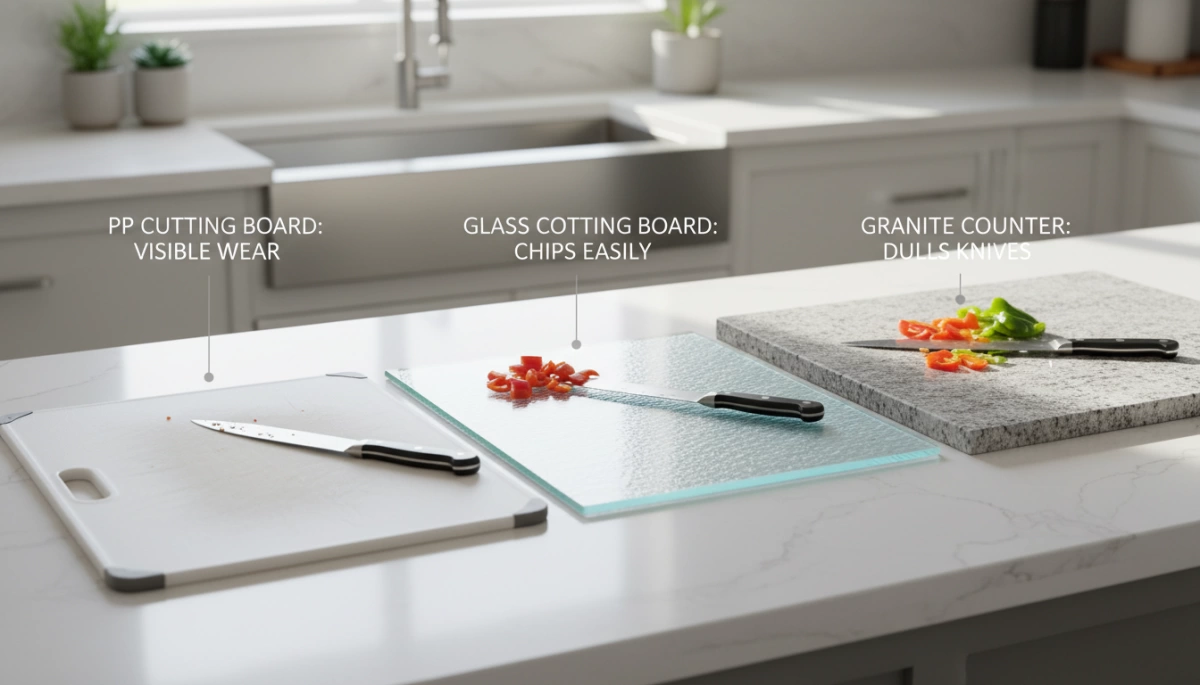
The Illusion of Durability
Glass and granite might look sleek and feel like the ultimate long-lasting kitchen tools, but their extreme surface hardness is actually a major flaw. While these rigid materials will technically outlast plastic, they destroy your knives in the process.
- Blade Ruin: Striking a sharp chef’s knife against unyielding glass, granite, or marble rolls and dulls the blade’s edge almost instantly.
- The PP Advantage: We specifically engineer our high-density PP to serve as knife-friendly cutting surfaces. Polypropylene yields just enough to protect your expensive blades from dulling, without sacrificing the board’s own structural integrity.
Impact Resistance: Built for the Real World
In a fast-paced kitchen, true durability isn’t just about resisting scratches—it is about surviving daily accidents.
- The Shatter Risk: Drop a glass or stone board on a tile floor, and you are immediately left with dangerous shards, chipped edges, and a ruined product.
- Shock Absorption: PP naturally absorbs heavy impacts. If a PP board slips off your counter, it simply hits the floor and bounces back without a scratch.
When you are comparing durable prep surfaces for a busy prep station, PP is practically indestructible against the accidental drops and heavy impacts that instantly destroy harder, heavier materials.
PP vs. Rubber and TPU: The Professional Tier
When you step into a high-end restaurant kitchen, you often see thick rubber cutting boards. They are a staple for a reason. Commercial rubber is exceptionally durable and gentle on knife edges. But for everyday use—even in busy prep stations—it has serious drawbacks. Rubber boards are heavy, expensive, and a hassle to maneuver when it’s time to wash them in the sink.
This is where modern high-density plastic cutting boards come into play.
The Perfect Middle Ground
As a manufacturer, finding the sweet spot between durability and practicality is our top priority. When building our custom cutting board brand, we focused on how high-density PP and advanced materials like TPU offer the best of both worlds.
Here is how commercial grade PP prep boards stack up against heavy-duty rubber:
- Weight & Practicality: PP gives you a reliable, durable prep surface at a fraction of the weight of rubber. You can easily pick it up, scrape ingredients into a pan, and load it into the dishwasher without straining your wrists.
- Knife-Friendly Cutting Surfaces: Advanced PP and TPU provide a similar “give” to rubber. They absorb the impact of the blade to protect the board’s structural integrity while preventing your chef’s knives from dulling prematurely.
- Cost-Effectiveness: You get professional-level scar resistance and long-lasting kitchen tools without the premium price tag of commercial rubber blocks.
Ultimately, whether you are running a restaurant line or cooking at home, PP delivers that professional-tier knife feel without the literal heavy lifting.
Hygiene and Scratch Resistance in PP Boards
The Bacteria Trap
When comparing plastic vs wood cutting board durability, the most critical issue is always hygiene. Low-density, cheap plastics scar easily and deeply. These deep grooves become a permanent trap for moisture and food particles, allowing bacteria to multiply up to 40% faster than on a high-quality, non-porous chopping block. If a board holds onto germs, its physical lifespan doesn’t matter—it is no longer safe to use. Proper cutting board maintenance and hygiene require a surface that resists these deep gouges in the first place.
The High-Tech Solution
Physical toughness and food safety must go hand in hand. We solve the bacteria trap by building active protection directly into the material. By integrating advanced silver-ion technology into our antibacterial cutting boards, we ensure the surface actively fights contamination from day one.
Here is how this high-tech approach extends your PP cutting board durability:
- 99.9% Growth Halt: Microban protection actively stops microbes from reproducing inside knife marks.
- Safe Scratches: As minor, inevitable scratches appear over years of heavy chopping, the newly exposed plastic remains entirely biologically safe.
- Zero Compromise: You get a food-safe plastic cutting surface that stays hygienic through thousands of meals.
This combination of scratch resistance and active microbial defense is exactly what turns a basic piece of plastic into reliable, long-lasting kitchen tools for both home and commercial use.
4 Ways to Maximize the Polypropylene Chopping Board Lifespan
Even with exceptional PP cutting board durability, everyday kitchen habits dictate how long your gear actually lasts. To get the absolute most out of your high-density plastic cutting boards, we recommend following these straightforward guidelines.
1. Proper Knife Usage
Preventing deep scratches in plastic boards starts with reaching for the right blade.
- Avoid serrated knives for prep: Using a jagged bread knife for heavy chopping acts exactly like a saw, ripping into the plastic surface.
- Stick to straight edges: Standard chef’s knives, paring knives, and santokus are perfect. They glide across the PP material without gouging it, which protects both the board’s surface and the sharp edge of your blade.
2. Smart Cleaning Protocols
When it comes to cutting board maintenance and hygiene, PP is incredibly forgiving, but it still has a few rules.
- Leverage the dishwasher: These are inherently dishwasher safe cutting boards. The high heat cleans and sanitizes the non-porous surface effortlessly.
- Ditch the abrasive scrubbers: If you choose to hand wash, avoid steel wool or harsh scouring pads. Aggressive scrubbing creates micro-scratches over time, dulling the finish of your board and compromising its smooth, hygienic surface.
3. Kitchen Heat Management
While high-quality PP is engineered as a warping resistance kitchen board, it is not completely fireproof.
- Keep away from the stove: Never place your board directly on a hot stovetop, toaster oven, or right next to an open flame.
- Preserve the flat surface: Exposing the plastic to direct, localized extreme heat can warp its flat structure, making it rock on the counter and creating an unstable, unsafe prep station.
4. Knowing When to Retire It
Even long-lasting kitchen tools eventually reach the end of their run. Clear signs it is time to upgrade include excessive deep scarring, stubborn discoloration that will not wash out, or any structural warping.
- Guilt-free replacement: When it is time for a fresh surface, you do not have to worry about adding to landfill waste. As a dedicated Calmchop cutting board manufacturer, our zero-waste production process ensures your kitchen upgrades remain environmentally responsible. Exploring how PP cutting boards and sustainability work together proves you can maintain a professional, durable prep surface without sacrificing your eco-friendly values.
 English
  German
  Turkish
  Italian
  Russian
  Polish
  Arabic
  French
  Malay
Malay  Japanese
  Korean
  Thai
Thai