
If your kitchen drawers are packed, your counter is always cluttered, and chopped veggies keep rolling off your board… you’re not alone.
Modern kitchens are getting smaller. But cooking at home? Still as messy as ever.
That’s exactly why space‑saving kitchen gear is exploding in 2025—and why foldable plastic cutting boards are quickly becoming a true must‑have.
These smart boards fold into a built‑in chute so you can slice, squeeze, and pour straight into your pot or pan—without spilled onions, extra bowls, or wasted space. They store flat, weigh almost nothing, and clean up in seconds.
In this guide, you’ll see why foldable cutting boards (especially the new designs from Calmchop) are replacing bulky, traditional boards in small apartments, RVs, dorms, and even full-size family kitchens.
Ready to upgrade to a compact, mess‑free, 2025‑ready kitchen setup? Keep reading.
The Rise of Space-Saving Kitchen Gear in 2026
If you cook in a small kitchen, you’re probably tired of one thing: clutter. In 2026, more of us are living in urban small apartments, studio spaces, dorms, RVs, and even tiny homes, and that’s forcing a real shift in how we buy kitchen gear. Oversized cutting boards, bulky gadgets, and single-use tools just don’t make sense when every inch of counter and cabinet space matters.
That’s why space-saving kitchen tools and small kitchen gadgets are exploding right now. This year’s modern kitchen trends lean hard into:
- Compact, multifunctional kitchen gadgets that do more than one job
- Collapsible kitchen gear that folds, stacks, or hangs flat
- Minimalist kitchen tools that stay out of the way when you’re not using them
Right in the middle of this shift are foldable plastic cutting boards. They solve a daily pain point: you need a solid, knife-friendly cutting board, but you don’t have room to store a giant slab of wood. A foldable cutting board or collapsible chopping board gives you a full-size surface when open, then folds into a slim, compact cutting board that tucks into a drawer, vertical slot, or RV cabinet.
You’ll see these space-saving cutting boards all over social and shopping sites in 2026 because they hit three things people care about:
- Space-saving kitchen gear that actually reduces clutter
- Modern small kitchen gear that looks clean and organized on camera
- Practical upgrades that make meal prep faster, cleaner, and easier
From college dorms to camper vans, foldable plastic cutting boards are becoming a core tiny kitchen solution: portable, light, easy to store, and built for the way people really cook in small spaces today.
What Makes Foldable Plastic Cutting Boards Unique?
Foldable plastic cutting boards aren’t just “another kitchen gadget” – they fix real problems in small, busy American kitchens.
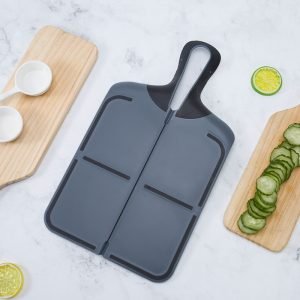
How Foldable Cutting Boards Work
Most foldable cutting boards use:
- Built-in hinges or fold lines down the center
- A flexible plastic body that bends but springs back flat
- A built-in chute that appears when you fold the sides up
You chop on the flat, non-slip cutting surface, then simply fold and pour. The sides angle up to form a funnel-like chute, so diced onions, peppers, or sliced chicken go straight into the pot or container instead of all over your stove.
Folding Chute = Mess-Free Food Transfer
The folding chute design is what makes a foldable plastic cutting board a real upgrade:
- Lift by the handle, fold slightly, and you’ve got a controlled pour spout
- Food slides into bowls, pans, meal prep containers, even narrow blender jars
- Less wiping down the counter, less food waste, and fewer dishes to juggle
If you’re into smarter, cleaner prep, this kind of mess-free food transfer is exactly what’s driving modern foldable cutting board trends in 2026.
Plastic vs. Wood or Bamboo
Wood and bamboo are great, but they don’t fold. Foldable plastic cutting boards stand out because they’re:
- Moldable: Plastic can flex without cracking, which is why the hinged cutting board design works
- Lighter: Easier to grab, flip, and pour with one hand
- More consistent: No grains, knots, or warping like cheaper wood and bamboo can have over time
For many U.S. home cooks, that means using plastic boards for daily chopping and wood for serving or special tasks.
Lightweight, Flexible, and Knife-Friendly
A good compact cutting board should feel light but solid:
- Lightweight and flexible so you can bend and carry even when it’s loaded
- Knife-friendly plastic that won’t dull blades like glass or cheap hard plastic
- Enough thickness to feel sturdy but still fold smoothly
This makes them perfect for quick weeknight cooking, small apartments, dorms, and RV kitchens.
Non-Porous Plastic = Better Hygiene
Quality non-porous plastic doesn’t soak up juices or odors like some wood boards can:
- Easier to rinse clean and dishwasher-safe on most models
- Less risk of bacteria and cross-contamination, especially with meat and seafood
- More stain-resistant when you’re cutting tomatoes, beets, or sauces
If food safety matters to you, it’s worth understanding how a non-porous cutting surface and even white cutting board designs can help you avoid stains and bacteria, as covered in this guide on white cutting boards and food safety.
Design Details That Actually Matter
The best space-saving cutting boards come down to the small details:
- Non-slip grips or base so the board doesn’t slide while you chop
- Ergonomic handle for easy lifting, hanging, and pouring
- Raised edges or juice grooves to keep liquids from running onto your counters
These design touches turn a basic plastic chopping mat into a reliable, everyday modern small kitchen gear upgrade you actually reach for every day.
Key Benefits: Why Foldable Plastic Cutting Boards Are 2026’s Must‑Have
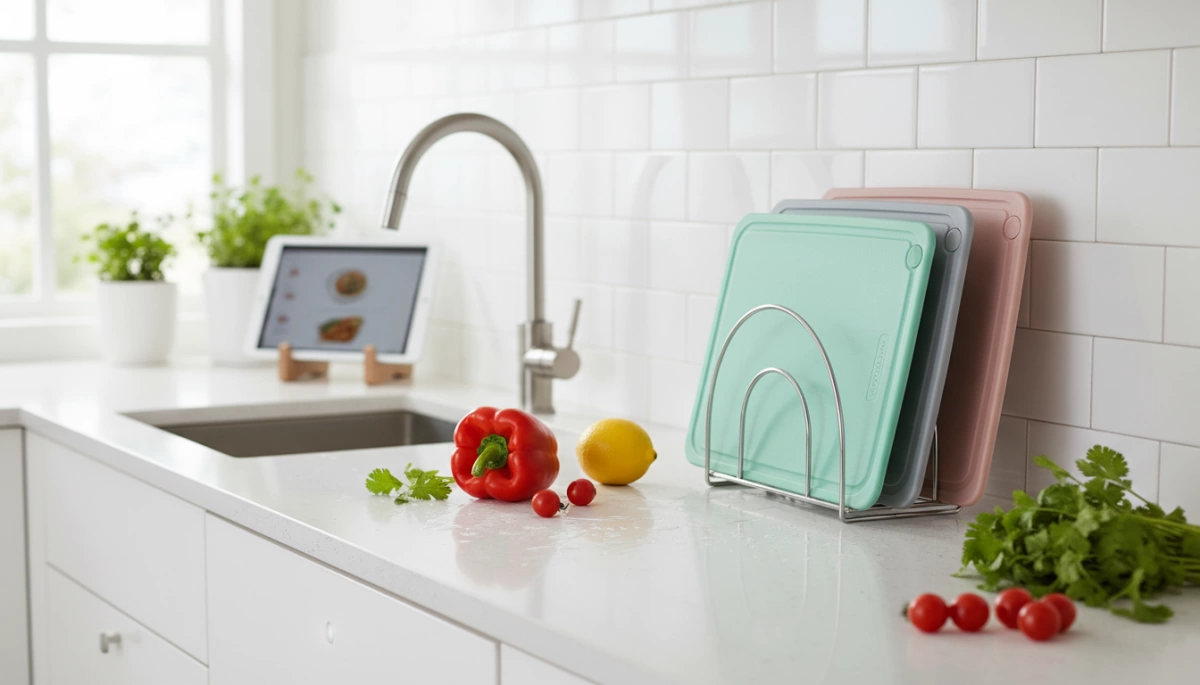
Foldable plastic cutting boards are the kind of space-saving kitchen gear that actually change how you cook, especially in tight U.S. kitchens, RVs, and rentals.
Space-Saving Design + Easy Storage
These foldable cutting boards are built for small spaces:
- Slim, collapsible profile – fits where thick wood boards can’t
- Slides into shallow drawers, vertical slots, or cabinet doors
- Hangs easily on hooks or pegboards
- Tucks into RV cabinets, camper bins, or dorm shelves
| Space Type | Best Storage Spot |
|---|---|
| Studio apartment | Vertical slot beside fridge/oven |
| Suburban kitchen | Drawer organizer or hanging hooks |
| RV or camper | Inside cabinet door or thin drawer |
| Dorm room | Hook on wall or side of mini fridge |
Faster, Cleaner Food Prep
The folding chute design isn’t a gimmick—it saves time and mess:
- Chop → fold-and-pour straight into bowls, pans, or containers
- Less food sliding off the sides compared to flat boards
- Fewer crumbs, onion bits, and juice on your counter and stovetop
- Great for quick weeknight meals and bulk veggie chopping
Versatile for Home, Travel, and Outdoors
A compact cutting board that actually travels well:
- Everyday home cooking and meal prep
- Camping cutting board for outdoor tables and grill setups
- RV kitchen accessory that doesn’t hog space
- Parks, tailgates, and picnics—lightweight and easy to pack
Hygiene + Safety Benefits
Modern foldable plastic cutting boards are built with hygiene in mind:
- BPA-free foldable board materials safe for food contact
- Non-porous cutting surface – less likely to trap juices and bacteria
- Better odor resistance than many wood or bamboo boards
- Stain-resistant cutting board – holds up better to tomato, beet, turmeric
For deeper hygiene upgrades, I also pair mine with an antibacterial cutting board from our eco-friendly plastic cutting board collection.
Durability for Daily Use and Meal Prep
Good foldable boards are built to flex without failing:
- Reinforced hinge or fold lines that handle daily bending
- Flexible yet knife-friendly cutting board surface that won’t dull blades fast
- Designed to resist cracking, warping, or splitting when used normally
- Perfect for meal prep and batch cooking since you can chop, fold, and pour over and over without stopping
If you meal prep on Sundays, a solid foldable plastic cutting board lets you move quickly from veggies → protein → fruit with less mess and zero storage headache.
Calmchop Foldable Plastic Cutting Boards: Product Deep Dive
What makes Calmchop different
I design Calmchop foldable plastic cutting boards for real small kitchens, not just pretty photos. Compared with generic foldable cutting boards, Calmchop focuses on three things:
- Stronger hinges that fold smoothly but don’t get flimsy after a few months
- Thicker, premium BPA-free plastic that doesn’t feel cheap or floppy
- True non-slip base and edges so the board doesn’t skate across your counter
Most collapsible chopping boards are basically thin plastic mats. Calmchop is built more like a solid cutting board that just happens to fold.
Core features that matter every day
Here’s what you actually feel when you use a Calmchop foldable plastic cutting board:
- Patented folding design
- Clean, defined fold lines that snap into a trough for easy pour
- No awkward bending or fighting the board to keep it folded
- Premium BPA-free, food-safe plastic
- Non-porous cutting surface for better hygiene
- Gentle on knives but firm enough to feel stable
- Non-slip base
- Grippy feet or edges so it stays put on wet or smooth counters
- Safer chopping, especially with faster knife work
If you’re already thinking about material choices across your kitchen tools, I’d also recommend looking at Calmchop’s overview of different cutting board materials and usage scenarios to match your board to how you cook.
Sizes and colors for real kitchens
I built the Calmchop lineup to work in tight American kitchens—apartments, condos, dorms, RVs, and small homes:
- Size options
- Compact: great for dorms, RV kitchen accessories, and single-meal prep
- Medium: daily driver for most urban apartment kitchens
- Large: meal prep, families, and batch cooking
- Color options
- Light neutrals for minimalist kitchens
- Darker colors for hiding stains and heavy use
- Color-coding sets for separating meat, veggies, and fruit
This keeps your space organized while still looking clean and modern.
How Calmchop improves your cooking workflow
The Calmchop foldable cutting board is built to speed up prep in small spaces:
- Chop → fold chute → pour into pan, pot, or container
- Keep everything on one compact cutting board instead of grabbing extra bowls
- Stand the board on its side in a narrow slot or hang it—no bulky storage needed
You spend less time wiping counters and more time actually cooking.
Real-world use cases
Here’s how most US customers use Calmchop in day-to-day cooking:
- Veggies: dice onions, peppers, and carrots, then fold and slide straight into a skillet
- Meat: trim chicken or steak on a dedicated color board to keep things more hygienic
- Fruit: slice melon or citrus, then fold and pour juice and pieces into a bowl without spills
- One-board meal prep: chop protein, veg, and herbs in sequence, rinse between steps, and keep everything moving on a single board
For outdoor cooking, a Calmchop portable kitchen cutting board also doubles as a camping cutting board—lightweight, space-saving, and easy to pack.
Why Calmchop fits minimalist, organized kitchens
If you’re trying to keep your kitchen clutter-free and modern, Calmchop checks the boxes:
- Folds flat for compact kitchen organization in drawers, vertical racks, or RV cabinets
- Clean, simple lines and colors that match minimalist kitchen tools
- Replaces multiple bulky boards with a space-saving cutting board set that actually stacks well
For brands and buyers who care about sustainability and smart plastic choices, Calmchop also leans on the same thinking used in our guide on choosing recyclable plastic cutting boards under modern environmental policies.
Bottom line: Calmchop foldable plastic cutting boards are built as real everyday tools for small space kitchens—not just another 2026 gadget trend.
How to Choose the Right Foldable Plastic Cutting Board for Your Kitchen
Pick the Right Size for Your Space and Cooking Style
When you’re dealing with a small kitchen, studio, or RV, size is everything.
Quick size guide:
| Cooking Style / Space | Recommended Board Size | Why It Works |
|---|---|---|
| Studio / dorm / tiny kitchen | 8″–10″ compact foldable board | Fits small counters, easy to store upright |
| Everyday home cooking | 10″–14″ medium foldable board | Enough room for veggies, fruit, and proteins |
| Family meal prep / batch cook | 12″–16″+ large foldable board | More chopping space, fewer trips to the trash |
| RV, camping, tailgates | Lightweight 9″–12″ foldable board | Packs easy, doubles as tray or serving board |
If your counter is tight, measure the depth of your main prep zone and choose a foldable cutting board that leaves at least 2–3″ of clearance in front so it doesn’t hang off the edge.
Material Quality and Thickness Matter
Not all foldable plastic cutting boards are built the same. I always look at:
- Material: Food-grade, BPA-free plastic only
- Thickness:
- Too thin = floppy, warps easily
- Too thick = heavy, loses the “flexible” advantage
- Feel: Slight flex, but not “bendy” when fully loaded with chopped food
- Surface: Knife-friendly (no harsh glass-like finish that dulls blades)
If you want a deeper dive on safe materials and which plastics are best for health and durability, check out this guide on choosing cutting boards that protect your health.
Useful Extras That Actually Help
Small design details are what make a compact cutting board feel premium in daily use:
- Juice grooves – Keep meat and tomato juices from running onto the counter
- Hanging holes – Easy vertical storage on hooks or a pegboard
- Measurement marks – Handy for quick slicing, portioning, and meal prep
- Pour spouts or folding chute – Cleaner, mess-free food transfer into pans and containers
- Non-slip grips / feet – Essential on smooth quartz or granite counters
These extras cost a bit more, but they turn a simple foldable plastic cutting board into a real space-saving kitchen tool.
Match the Board to Your Lifestyle
Different setups need different boards:
- Studio apartments / urban small kitchens
- One medium foldable cutting board with a chute
- Non-slip base + hanging hole for vertical storage
- Family kitchens
- A board set (meat, veg, fruit) to avoid cross-contamination
- Larger boards with grooves and measurement lines for meal prep
- RVs and camping
- Lightweight, compact, easy-to-pack boards
- Prefer a portable cutting board with fold-and-pour design and non-slip grips for uneven outdoor surfaces
For mixed setups (home + RV), I like to keep my sturdier, thicker board at home and a lighter collapsible chopping board dedicated to travel.
Balance Cost, Value, and Lifespan
You don’t need the priciest board, but ultra-cheap usually means ultra-disposable.
Look for:
- Mid-range price point with:
- Solid hinges
- BPA-free non-porous plastic
- Non-slip details
- Real value indicators:
- Won’t warp in a dishwasher
- Doesn’t stain easily from turmeric, tomato, or berries
- Can handle daily use without deep grooves forming too fast
If you’re already investing in organized, compact kitchen accessories, it makes sense to pick a foldable cutting board that will actually last a few years instead of a few months.
Red Flags: Low-Quality Foldable Cutting Boards to Avoid
When I’m sourcing or testing boards, I pass immediately on anything with:
- Strong chemical smell out of the package
- Very sharp hinge lines that feel like they’ll crack after a few folds
- Super glossy, hard plastic surface that’s slippery and rough on knives
- Wobbly or peeling non-slip pads
- Edges that feel rough or unfinished
- Obvious warping after a few hot washes
If a foldable plastic cutting board feels flimsy in your hands or doesn’t sit flat on the counter, it’s not a good fit for a modern small kitchen that needs reliable, space-saving gear.
Real-User Tips for Using Foldable Plastic Cutting Boards
Smart chopping that protects your knives and board
To keep your foldable plastic cutting board and knives in good shape:
- Use straight up-and-down cuts, not heavy rocking or twisting on the hinge line.
- Avoid smashing bones or frozen food on a foldable cutting board—use a heavier wood board for that.
- Stick with sharp knives; dull blades force you to press harder and can gouge the plastic.
- Chop most of your food in the center flat zone, not directly over the fold lines.
How to load and fold without stressing the hinges
The hinge is the heart of any foldable plastic cutting board, so I treat it gently:
- Chop first, then pull food toward the center before lifting.
- Support the board with two hands on the handles/edges when folding.
- Fold slowly so the hinged cutting board design bends naturally instead of snapping shut.
- Don’t overload—if you’re batch cooking, fold and pour in 2–3 smaller transfers instead of one huge pile.
Mess-free food transfer tricks
To get that true mess-free food transfer everyone wants:
- Fold the board into a V shape or chute, then angle it so food slides straight into the pot or bowl.
- For tiny items (minced garlic, herbs), tap the back of the board lightly instead of shaking it hard.
- Hold the tip of the folded chute just inside the pan so pieces don’t bounce off the rim.
- For sauces or meat juices, use boards with juice grooves or spouts—like many double-sided plastic cutting boards with juice grooves—to avoid spills on the stove.
Pairing with other space-saving kitchen gear
A space-saving cutting board set works even better with other compact tools:
- Keep your foldable cutting board next to collapsible colanders, nesting bowls, and stackable containers for tight kitchen setups.
- In RVs and small apartments, hang it on a wall hook or rail right above your prep zone.
- Use a non-slip cutting board mat or grippy drawer liner under it if your counters are slick.
Everyday hacks: trays, funnels, organizers
I use foldable cutting boards for more than just chopping:
- As a temporary tray to carry chopped ingredients from counter to grill or outdoor kitchen.
- Fold into a quick funnel to pour rice, beans, or coffee into jars and canisters.
- Use as a portable snack board for kids, then rinse and fold away.
- Lay it flat inside a drawer as a liner/organizer for spices or utensils during RV trips or camping.
These simple habits make a foldable plastic cutting board feel like a true space-saving kitchen tool, not just another gadget taking up room.
Care, Cleaning, and Maintenance for Foldable Plastic Cutting Boards
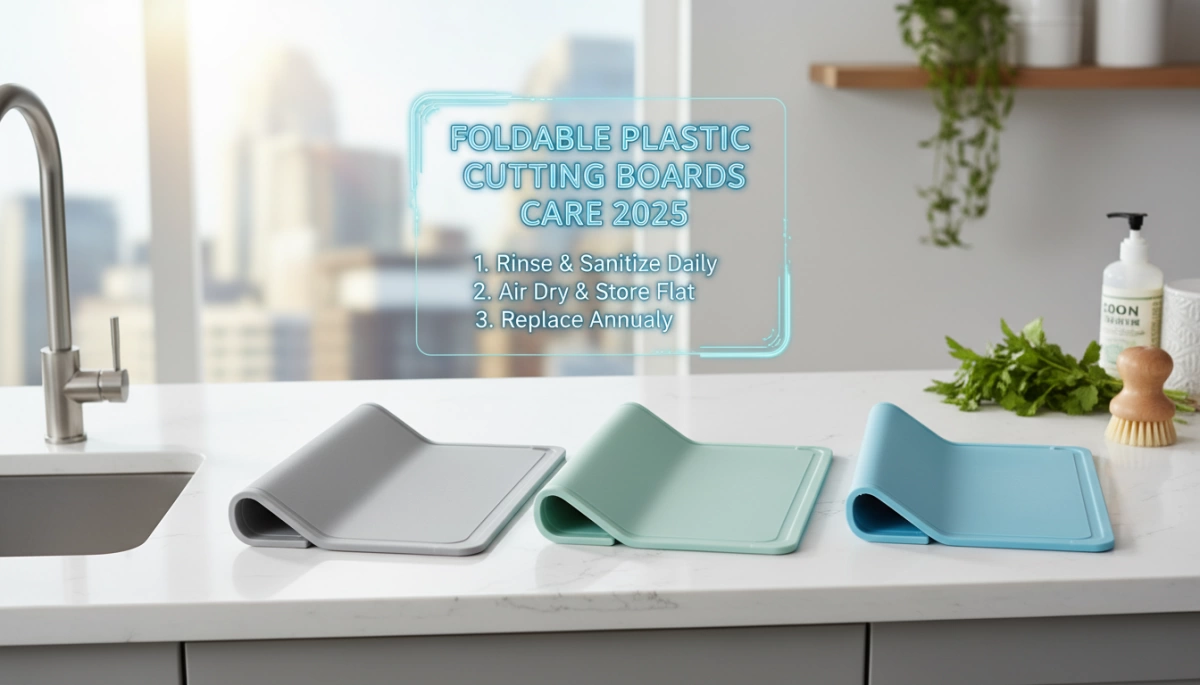
Dishwasher-safe vs. hand-wash foldable boards
For foldable plastic cutting boards, I always check the label first:
- Dishwasher-safe cutting boards: Load on the top rack, laid flat, not bent. High-heat cycles are fine for quality BPA-free boards, but avoid “sanitize” mode if the brand warns against it.
- Hand-wash only boards: Use hot water, mild dish soap, and a soft sponge. Skip steel wool or harsh scrubbers – they can scratch the non-porous cutting surface and wear down hinges faster.
If you’re upgrading other boards too, it helps to know how to choose the right nonslip cutting board size so your dishwasher and cabinets aren’t overloaded.
Simple routines to avoid stains and odors
Foldable plastic cutting boards are naturally stain-resistant and odor-resistant, but a quick routine keeps them fresh:
- Rinse right after cutting tomatoes, turmeric, beets, or sauces.
- For lingering smells (onion, garlic, fish), scrub with:
- Baking soda + water paste, or
- White vinegar + water spray, let sit 5 minutes, then rinse.
- Avoid soaking overnight – it’s not needed and can stress cheaper hinges.
How to dry and store so they keep their shape
To keep a foldable cutting board from warping or twisting:
- Dry fully unfolded on a rack or towel.
- Let the hinges dry completely before stacking or hanging.
- Store:
- Vertically in a slot or cabinet organizer
- On a hook by the handle
- Flat in a drawer with no heavy pots on top
Avoid storing while bent or half-folded – over time that can “train” a cheap compact cutting board into a curve.
When to replace a foldable cutting board
Even a premium foldable plastic cutting board has a lifespan. I replace when I see:
- Deep knife grooves that don’t clean out
- Cracks along the hinged cutting board design
- Warped areas that don’t sit flat on the counter
- Loose hinge or folding chute that doesn’t lock like it used to
If raw meat juice can sit in a groove or crack, it’s time to retire that board for safety and hygiene.
Safe use with raw meat, seafood, and strong smells
For small US kitchens, separate boards are a game-changer:
- Use one BPA-free foldable board for raw meat and seafood, another for fruits and veggies.
- Always wash meat/seafood boards immediately with hot, soapy water (or a full dishwasher cycle).
- After cutting chicken, pork, or fish:
- Rinse off debris
- Wash, then sanitize with a mild bleach solution (1 tbsp bleach per gallon of water), rinse again, and air-dry fully.
For strong-smelling foods, use the fold-and-pour design to move everything straight to the pan, then wash right away. That’s how you keep a compact, modern small kitchen gear setup clean, safe, and ready for the next meal.
Foldable vs Traditional Cutting Boards: Which One Fits Your Kitchen?
Storage: Foldable vs Wood, Bamboo, and Glass
In a small U.S. kitchen, storage is everything.
- Foldable plastic cutting boards slide into tight vertical slots, narrow drawers, RV cabinets, or hang on a hook. They’re basically a space-saving kitchen gear cheat code.
- Wood and bamboo boards are bulkier. They look great on the counter, but they eat up drawer space fast.
- Glass boards are usually thin but heavy and not stack-friendly if you have multiple.
If you’re living in an apartment, dorm, RV, or tiny home, a compact foldable cutting board instantly frees up room for other small kitchen gadgets.
Portability for Camping, RVs, and Outdoor Cooking
For travel and outdoor cooking, the winner is clear:
- Foldable plastic boards are lightweight, tough, and pack flat. They’re ideal as a camping cutting board, RV kitchen accessory, or tailgate tool.
- Wood and bamboo are heavier and awkward to pack.
- Glass is a no-go for most people on the road—too heavy and too easy to chip or shatter.
If you camp, road trip, or grill outside often, a portable foldable cutting board earns its spot in your gear bag.
Cutting Feel and Knife Safety
How it feels to cut—and how it treats your knives—matters:
- Foldable plastic cutting boards (especially higher-quality BPA-free ones) are knife-friendly and slightly forgiving. They protect your blade edges better than glass and most cheap plastic.
- Wood and bamboo still feel the best to many cooks. They’re gentle on knives and great for heavy chopping.
- Glass is the worst for knives. It dulls blades quickly and can be slippery, so it’s not a knife-safe choice.
A well-designed foldable plastic cutting board with a non-slip base and flexible surface gives you a solid, safe everyday workhorse. If you’re into the details of how surface and material impact performance, it’s the same idea behind purpose-built premium boards.
When a Traditional Wood Board Still Makes Sense
I still like a traditional wood board in a few cases:
- You do a lot of heavy-duty chopping or butchering.
- You want a showpiece board that lives on your counter.
- You serve charcuterie, cheese, or steaks right on the board.
Wood is great for presentation and big prep jobs. It just isn’t space-saving or super portable.
Why Most Cooks Use Both
Most home cooks I talk to don’t choose one or the other—they combine:
- Use a foldable plastic cutting board for daily chopping, quick meal prep, fold-and-pour transfers, camping, and RV trips.
- Keep a wood or bamboo board for bread, carving, and serving.
A foldable cutting board becomes your everyday utility player, while traditional boards are your specialty tools. This combo gives you modern small kitchen gear that’s both practical and flexible without cluttering your space.
FAQs About Foldable Plastic Cutting Boards in 2026
Are foldable plastic cutting boards safe for knives and blades?
Yes. A good foldable plastic cutting board is designed to be knife-friendly. The surface should be:
- Slightly soft so it doesn’t dull your blades fast
- Smooth, without hard glass or stone texture
- Even across the hinge, so the knife doesn’t “catch” when you cut
That’s why I use thicker, premium plastic similar to what we use in our premium plastic cutting board lines, not thin brittle plastic sheets.
Do foldable cutting boards warp, crack, or loosen over time?
Cheap ones do. Quality foldable cutting boards hold up if:
- The hinge is molded into the board, not just a weak crease
- The board has enough thickness to resist bending and heat
- You avoid super high heat (no dishwashers on “sanitize” mode, no hot pans on top)
If you see deep cuts, heavy warping, or a loose hinge that won’t sit flat, it’s time to replace it for safety and hygiene.
Are foldable boards good for camping, RVs, and travel cooking?
Absolutely. A compact cutting board that folds is perfect if you cook in:
- RVs and campers with shallow drawers
- Small cabins or vacation rentals
- Outdoor setups, tailgates, and park grills
They’re lightweight, portable, and easy to pack, which is why a lot of RV owners treat them as must-have RV kitchen accessories and camping cutting boards.
How many foldable cutting boards do you really need in a small kitchen?
For a typical small U.S. kitchen, I recommend:
- 2–3 boards total
- 1 for meat/poultry
- 1 for fruits/veggies
- Optional 1 extra for bread/snacks or backup
If you prefer to separate raw meat from produce even more, a double-sided board like a stainless steel + plastic cutting board combo works great for that separation: double-sided meat and vegetable cutting board.
Are foldable plastic cutting boards recyclable or eco-friendly?
It depends on the plastic and your local recycling rules. Here’s how I look at it:
- Look for BPA-free and food-grade materials
- Choose durable boards that last years, not months
- Avoid ultra-cheap, disposable-style plastic mats
If you care about sustainability, pairing a long-lasting foldable plastic cutting board with a sturdy, reusable board (like a thick eco-friendly plastic board with grooves and handle, similar to this style of eco‑friendly plastic cutting board with handle and juice grooves) is a smart, low-waste setup for a modern, minimalist kitchen.
 English
  German
  Turkish
  Italian
  Russian
  Polish
  Arabic
  French
  Malay
Malay  Japanese
  Korean
  Thai
Thai