
What Is a Stainless Steel Cutting Board? Material Science Explained
A stainless steel cutting board is a rigid, metallic food preparation surface engineered for hygiene, longevity, and low-maintenance kitchen prep. Unlike organic or plastic cutting surfaces that absorb moisture and degrade over time, a metal board uses a solid, non-reactive alloy sheet crafted specifically to handle daily slicing, rolling, and food prep without warping or breaking down.
As manufacturers, we look at cutting boards through the lens of material composition. The performance of any steel board comes down to its specific alloy grade, surface finishing method, and edge machining standards.
304 Food-Grade Stainless Steel vs. 316 and 430 Alloys
Not all steel boards use the same metal. Choosing the correct grade is critical for food safety, corrosion resistance, and practical everyday use:
| Steel Grade | Alloy Composition | Corrosion Resistance | Best Kitchen Application |
|---|---|---|---|
| 304 Stainless Steel | 18% Chromium, 8% Nickel (18/8) | High (Resists organic acids and daily washings) | The industry standard for sanitary food prep surfaces |
| 316 Marine-Grade | 16% Chromium, 10% Nickel, 2% Molybdenum | Maximum (Resists harsh chlorides and salts) | Over-engineered for standard home kitchens; increases cost without daily prep benefits |
| 430 Steel | 16–18% Chromium, zero nickel (Ferritic) | Moderate (Can pit when exposed to prolonged acids) | Budget metal; magnetic, but prone to spotting over extended use |
We prioritize 304 food-grade stainless steel because it offers the optimal balance of rust defense against citrus and onions, physical durability, and reliable food safety.
Brushed vs. Mirror Surface Textures
The texture of the board directly controls how food interacts with the surface and how the metal wears:
- Brushed Finish: The metal surface is treated with directional abrasive graining. This soft, satin texture adds micro-friction to keep wet meats and round vegetables from sliding dangerously. Crucially, a brushed surface conceals micro-scratches and normal knife contact marks over time.
- Mirror Finish: Highly reflective and ultra-smooth. While visually striking out of the box, mirror surfaces cause wet foods to suction tight or skate freely across the board. Furthermore, every single knife pass leaves visible hairline scratches, ruining the clean look almost immediately.
For practical daily cooking, an industrial brushed finish is the superior choice for slip resistance and scratch concealment.
Laser-Cut Edges, Deburring, and Safety Corner Radiuses
A flat steel plate is useless if it is hazardous to handle. Turning raw sheet metal into a practical kitchen tool requires strict mechanical finishing:
- Precision CNC Laser Cutting: Cuts each board with exact dimensional tolerances, preventing sheet distortion and uneven board lie.
- Complete Deburring & Chamfering: Freshly cut sheet metal has razor-sharp flash along the perimeter. Proper edge chamfering rounds off all edges so you can grip, wash, and move the board without hand irritation.
- Safety Corner Radiuses: Sharp 90-degree corners create puncture hazards. We finish every perimeter with rounded safety radiuses, protecting countertops, sink basins, and your hands during daily washing.
Does a Stainless Steel Cutting Board Dull Your Knives?
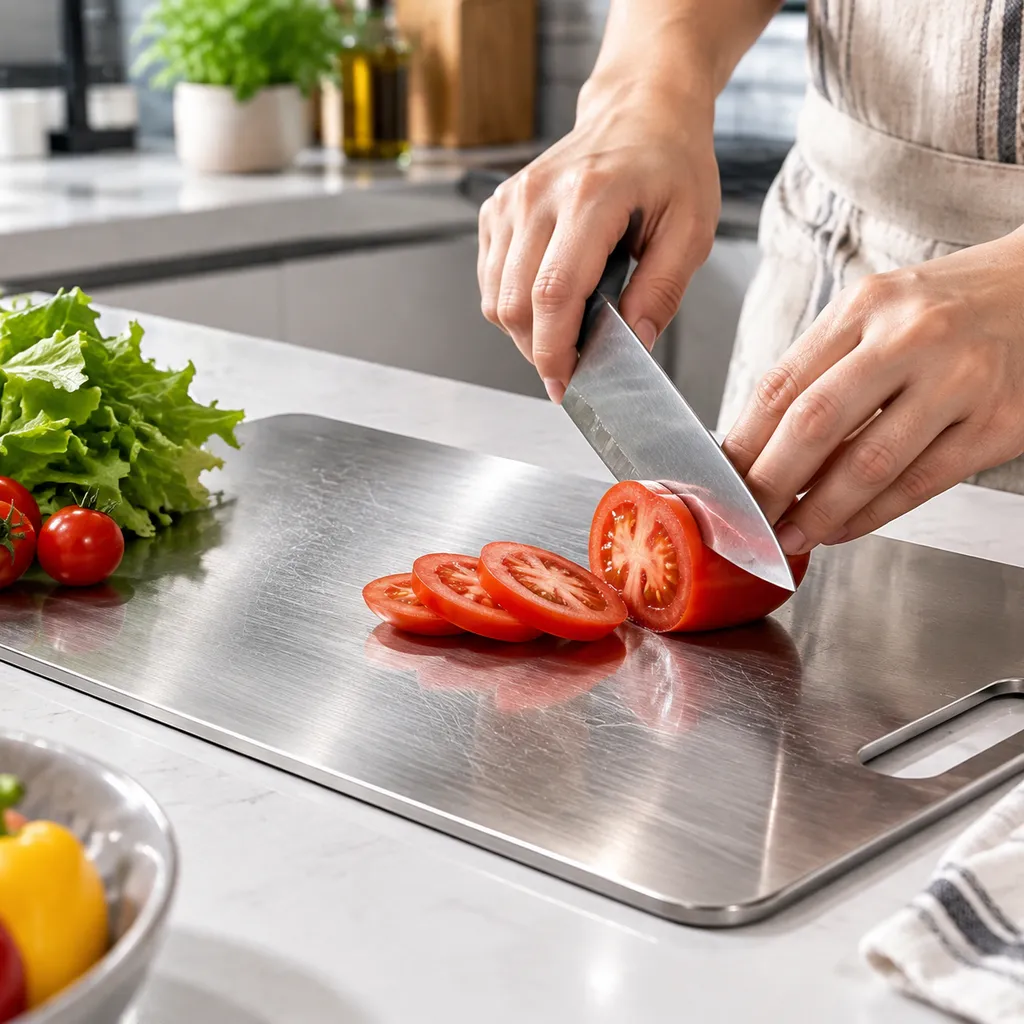
The short answer is yes—if you chop aggressively with the wrong blade. However, the science behind blade contact is not as destructive as most people assume. When we look at knife edge retention on metal surfaces, dulling comes down to the hardness difference between your knife and the board, along with how you cut.
Rockwell Hardness (HRC): Knife Steel vs. 304 Stainless Steel
Knives dull when they hit a surface harder than their own steel. Hardness is measured on the Rockwell C scale (HRC):
- 304 Food-Grade Stainless Steel Board: Roughly 80 to 90 HRB (translating to under 20 HRC).
- Standard German Chef Knives (Wüsthof, Zwilling): 56 to 58 HRC.
- Hard Japanese Blades (Shun, Global, carbon steels): 60 to 64 HRC.
Because an austenitic 304 stainless steel cutting board is significantly softer than cutlery steel, the board yields to the blade rather than the other way around. The board will take shallow surface scratches, which protects your knife apex from catastrophic failure. Still, repeatedly striking metal causes edge wear faster than striking end-grain wood.
Blade Edge Physics: Micro-Rolling vs. Apex Chipping
When a sharp knife edge contacts a stainless steel surface, one of two things happens:
- Micro-Rolling (Tougher, Softer Steels): Lower-HRC blades flex slightly under impact. The ultra-thin apex rolls over to one side. This is easy to fix with a standard ceramic honing rod in five seconds.
- Apex Chipping (Harder, Brittle Steels): High-HRC Japanese blades have high carbon content and narrow edge angles (12–15 degrees). Metal-on-metal impact can cause microscopic chips along the brittle edge rather than smooth rolling.
Slicing Technique: Push-Cutting vs. Rocking Chops
Your knife technique determines how long your edge lasts on a stainless steel chopping board:
- Push-Cutting and Slicing (Recommended): Moving the knife forward and down in a fluid stroke lets the sharp edge glide cleanly through food with minimal pressure on the board.
- Draw-Cutting (Recommended): Pulling the blade toward you minimizes vertical impact shock.
- Aggressive Rocking Chops (Avoid): Rocking forces the blade edge to twist against the steel surface under lateral friction, accelerating micro-rolling.
- Heavy Cleaver Smashing (Avoid): Slamming down vertically on unyielding steel dulls any apex instantly.
Best Knives to Pair with Metal Prep Surfaces
For everyday meal prep on a stainless steel board, choose the right tool for the job:
- Best Choice: Standard stainless steel utility knives and German chef knives (55–58 HRC). Their softer, ductile alloys handle metal contact gracefully and realign instantly on a honing steel.
- Use with Caution: High-end Japanese knives or custom high-carbon steels. Reserve these for soft wood boards, or use them strictly for delicate, non-contact slicing.
- Great Match: Serrated bread knives and utility slicers, where the recessed teeth stay protected from board contact entirely.
Key Benefits of Using a Stainless Steel Chopping Board
Switching to a stainless steel cutting board solves the sanitation and durability issues common to traditional kitchen surfaces. We prioritize materials that keep meal prep clean, fast, and simple.
Non-Porous Surface and Cross-Contamination Defense
Traditional boards absorb juices, blood, and moisture deep into microscopic pores and cut marks. A stainless steel cutting board provides a completely solid, non-porous cutting surface:
Zero liquid absorption: Fluids from raw poultry, beef, and seafood remain strictly on top.
Effortless sanitizing: Soap and hot water wash away surface residues without leaving hidden pockets for bacteria.
Safer separation: Makes raw meat and poultry prep far safer by preventing deep bacterial colonization.
Eliminating Kitchen Microplastics
Every stroke of a sharp knife on a polyethylene or polypropylene board chips off tiny polymer fragments directly into food.
Zero plastic shedding: Solid metal does not shed shavings or synthetic micro-shreds into your chopped ingredients.
No frayed edges: Eliminates the fuzzy, splintered texture that plastic boards develop after weeks of heavy chopping.
Clean meal prep: Keeps your cooking workflow focused on real food, not synthetic debris.
Natural Odor and Stain Immunity
Strong aromatics and deeply pigmented produce routinely ruin standard prep surfaces. Stainless steel resists chemical bonding with tough kitchen compounds:
Neutralizes strong aromatics: Crushed garlic, diced onions, and raw fish oils wash away without leaving ghost odors behind.
Stain-proof resilience: Highly pigmented items like beets, turmeric, red chilies, and berries wipe clean instantly without coloring the board.
Rapid Meat Defrosting Through Thermal Conductivity
Because steel conducts heat much faster than wood, air, or stone, a flat stainless steel board doubles as an unpowered defrosting plate for meat.
Faster thaw times: Laying frozen steaks, chicken breasts, or ground meat flat on the cold steel pulls heat from the ambient room directly into the food.
Maintains food quality: Thaws food evenly and safely at room temperature without par-cooking the edges the way microwave defrosting does.
Cool Surface for Pastry and Dough Kneading
Bakers benefit directly from the smooth, cool properties of steel when handling delicate doughs.
Temperature stability: The metal stays cooler than room temperature, keeping butter cold while rolling flaky pie crusts or laminating pastry dough.
Non-stick release: Dough releases easily from the polished flat surface with a light dusting of flour, making cleanup fast and mess-free.
| Core Benefit | Functional Kitchen Advantage |
|---|---|
| Non-Porous Surface | Prevents fluid absorption and stops cross-contamination at the surface level. |
| Microplastic-Free | Leaves zero synthetic shavings or gouged particles in diced ingredients. |
| Odor & Stain Proof | Rinses completely clean of pungent garlic, fish oils, and dark beet pigments. |
| Thermal Transfer | Conducts ambient room heat to rapidly thaw frozen cuts of meat. |
| Smooth & Cool Base | Keeps butter chilled during dough rolling, biscuit shaping, and pastry prep. |
Drawbacks of Metal Cutting Boards and Practical Fixes
Every kitchen prep surface comes with trade-offs. While a stainless steel cutting board solves serious hygiene and durability issues, working on a solid metal sheet introduces a few distinct quirks: acoustic noise, countertop sliding, and visible surface scuffs.
We look at these concerns directly and apply straightforward, practical fixes to eliminate friction during daily food prep.
Silencing Acoustic Feedback and Metal Slicing Clatter
The most common initial objection to a metal cutting board is sound. A knife blade striking a hard steel plate produces a distinct metallic contact sound that feels unfamiliar if you are accustomed to soft wood or plastic.
- Adjust your cutting stroke: Avoid aggressive vertical hacking. Shifting to a smooth forward push-cut or drawing slice keeps the blade in controlled contact with the food, instantly cutting down contact noise.
- Dampen base vibrations: Most acoustic clatter comes from resonance between the board and a hard granite or quartz countertop. Placing a damp kitchen towel, a thin silicone prep mat, or rubber resting feet beneath the board deadens sound vibrations completely.
- Reserve heavy chopping for dedicated tools: Heavy cleavers designed for bone-in butchery belong on thick end-grain blocks. Standard chef’s knives, santokus, and utility knives operate quietly on steel when guided with standard slicing technique.
Preventing Countertop Slippage with Anti-Slip Silicone Borders
A bare steel slab on a polished stone, tile, or laminate counter creates minimal friction, which can lead to slipping during vigorous prep work. Stability is critical for knife safety.
| Risk Factor | Root Cause | Practical Fix |
|---|---|---|
| Lateral Sliding | Smooth steel base against smooth stone counter | Equip the board with an anti-slip silicone border or snap-on corner bumpers. |
| Uneven Work Station | Slight counter deflection or wet surfaces | Place a silicone baking mat directly underneath to create an immovable vacuum seal. |
| Fluid Migration | Juices leaking under the board, reducing grip | Use boards engineered with integrated juice grooves and raised rubberized feet to keep the base dry. |
We design our prep surfaces with integrated silicone edging to ensure the board locks firmly to the counter, keeping your work area stable and safe through heavy prep sessions.
Managing Normal Surface Scuffs, Knife Marks, and Cosmetic Patina
A stainless steel cutting board will show knife marks. This is intentional physics: for a board to preserve knife edges as much as possible, the steel surface must yield slightly to micro-abrasion from hardened blade apexes.
- Understanding functional patina: Fine hairline scratches on brushed 304 food-grade stainless steel are strictly cosmetic. Unlike wood or plastic, these superficial lines do not open deep fissures where bacteria, moisture, and food particles get trapped. The surface remains completely non-porous.
- Brushed finish advantages: Choosing a brushed surface texture rather than a high-mirror polish conceals normal scratches and prevents visible glare under bright kitchen task lighting.
- Restoring surface appearance: Routine dishwashing keeps the board sanitized, but if fine scuffs catch residue or show water spots, buffing along the grain with a non-abrasive pad and a paste of baking soda easily evens out the finish.
Accepting normal cosmetic wear allows you to focus on what matters: clean, safe, and hygienic food prep without shedding plastic or absorbing liquids.
Material Comparison: Stainless Steel vs. Traditional Cutting Surfaces
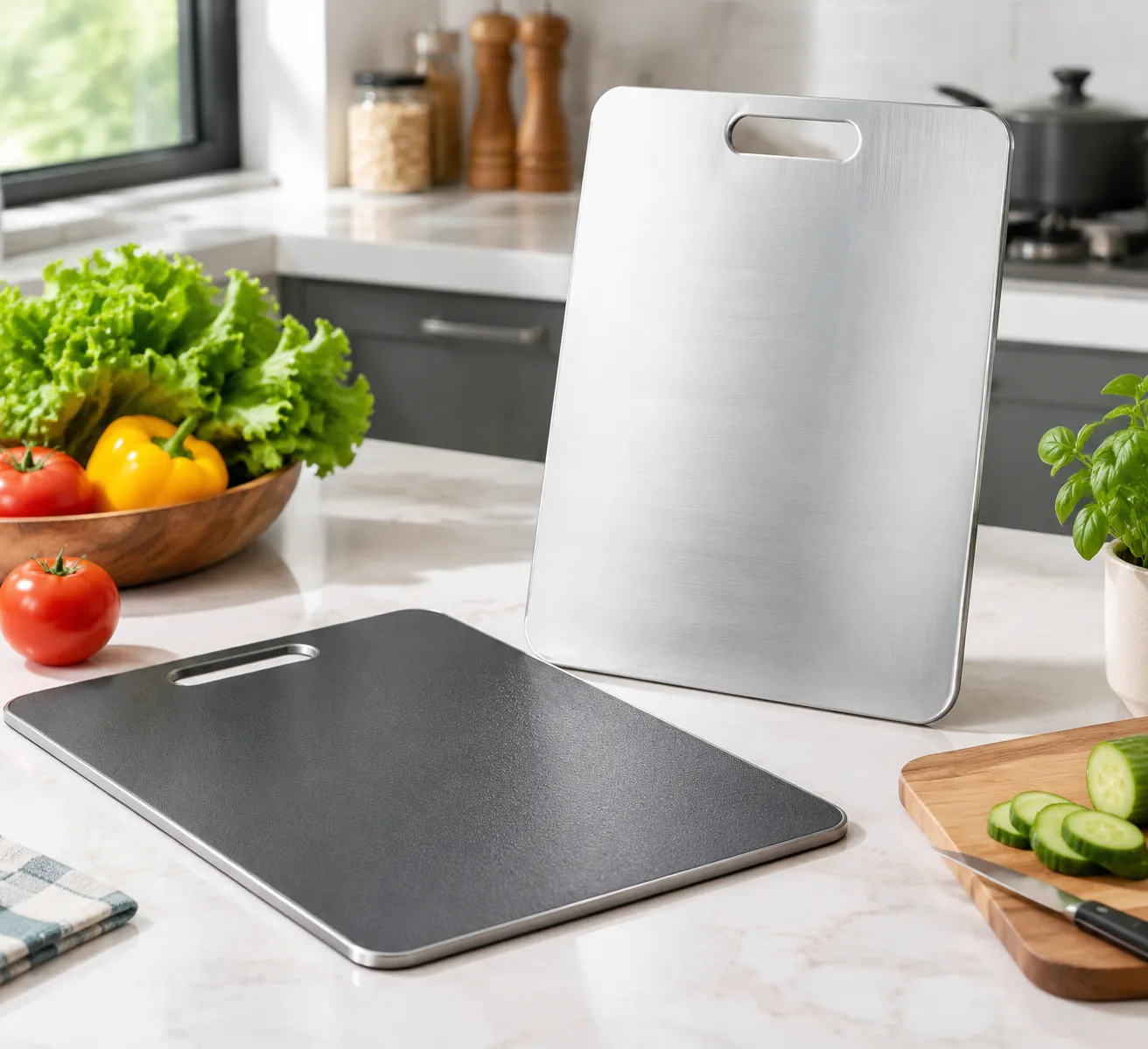
We test prep surfaces under demanding kitchen conditions every day. Hardwood absorbs moisture, plastic gouges easily, and stone destroys blade apexes instantly. A stainless steel cutting board solves the sanitation and durability gaps of traditional prep boards, but each material brings distinct tradeoffs to the counter.
Performance Matrix: Steel vs. Wood, Plastic, and Composites
| Prep Surface | Hygiene & Odors | Blade Edge Impact | Dishwasher Safe | Microplastic Shedding | Care Required |
|---|---|---|---|---|---|
| 304 Stainless Steel | Maximum (Non-porous) | Moderate | Yes | Zero | Very Low |
| End-Grain Hardwood | High (Natural tannins) | Minimal (Gentle) | No (Hand wash) | Zero | High (Oiling & waxing) |
| HDPE Plastic | Low (Grooves harbor microbes) | Low | Yes | High | Low |
| Eco-Composites | High (Dense matrix) | Moderate | Yes | None | Low |
- Wood vs stainless steel board: Wood offers premium blade forgiveness, but it cannot be sanitized in a high-heat dishwasher and warps under prolonged moisture.
- HDPE plastic: Inexpensive and soft, but knife cuts quickly carve micro-trenches that trap poultry fluids and release synthetic particles into food.
- 304 food-grade stainless steel: Impervious to blade gouges, stains, and organic fluids. It provides an absolute barrier against cross-contamination.
Rise of Double-Sided Hybrid Cutting Boards
Relying on a single material for every kitchen prep task creates compromises. The double-sided chopping board solves this by dividing kitchen duties across two specialized working faces:
- The 304 steel side: Engineered for raw meat and poultry prep, seafood, and pungent items like garlic and onions. The zero-porosity surface prevents fluid absorption, contains bacteria at the surface level, and cleans off with a single wipe.
- The composite side: Engineered for slicing vegetables, carving bread, and delicate produce where traditional knife feel and blade preservation take priority.
Using a dedicated hybrid platform keeps raw proteins and fresh ingredients completely isolated without taking up counter space with multiple individual boards.
Calmchop Dual-Surface Engineering
We designed Calmchop to bring industrial food safety into the home kitchen without sacrificing everyday practicality. Our dual-surface design pairs heavy-gauge 304 stainless steel with a high-density, eco-friendly composite prep surface.
- Targeted task management: Slice raw steaks on the antibacterial steel plate, flip the board, and immediately prepare your garnishes on the composite surface.
- Rigid multi-layer core: Eliminates the tinny vibration and flex common in standalone sheet metal boards, providing a solid, grounded cutting feel.
- Molded perimeter grip: An anti-slip border locks the board securely against granite, quartz, and butcher block counters on both sides.
- Sustainable prep: Blending durable steel with eco-friendly kitchen accessories creates a reliable, microplastic-free kitchen setup that outlasts traditional plastic boards by years.
Buyer’s Guide: Choosing the Best Stainless Steel Cutting Board
Finding the right metal board comes down to construction and daily usability. We focus on four practical standards before adding any stainless steel cutting board to a prep station:
Optimal Steel Thickness and Rigidity
Avoid flimsy sheet metal under 1.5mm. Super-thin metal plates flex under normal knife pressure, warp under heat, and rattle loudly across the counter.
Target gauge: Look for a solid thickness of at least 1.5mm to 2mm, or a heavy dual-sided composite design.
Why it matters: Extra thickness ensures a rigid, flat chopping surface that absorbs impact without flexing or bowing.
Smooth Chamfered Edges for Safety
Raw laser-cut metal edges can be surprisingly sharp. Premium board engineering requires proper edge treatment to protect your hands:
Chamfered and deburred edges: Removes micro-burrs left from manufacturing, leaving silky, safe perimeters.
Rounded corner radiuses: Blunted corners eliminate snag points, protecting your skin and washcloths during cleanup.
Deep Juice Grooves for Clean Prep
Carving cooked roasts or slicing water-heavy produce quickly floods flat surfaces.
Look for an integrated juice perimeter deep enough to hold run-off fluids.
Effective containment keeps counters dry and prevents raw poultry and meat juices from spilling onto surrounding surfaces.
Balanced Weight, Ergonomics, and Sink Portability
A board must balance countertop stability with easy handling at the sink:
Counter stability: Enough heft to stay anchored during aggressive prep, reducing unwanted movement.
Sink clearance: Verify that the board dimensions fit comfortably inside your standard kitchen sink basin. If the board is too bulky to rinse flat under the tap, daily washing becomes an awkward chore.
Cleaning, Sanitization, and Knife Care Protocols
Maintaining a stainless steel cutting board takes far less effort than oiling butcher blocks or scrubbing grooved plastic, but keeping the metal pristine and your blades razor-sharp still requires the right routine. We rely on a few straightforward cleaning habits and edge-care practices to get the best performance out of our prep station every day.
Daily Soap-and-Water Washing vs. High-Heat Dishwasher Sanitization
One of the greatest advantages of metal over porous wood is true cleanup versatility. You can switch between quick counter washes and deep thermal sterilization depending on what you are cooking.
- Quick Hand Washing: For produce, bread, or quick prep, standard dish soap and warm water with a non-scratch sponge clear residue in seconds. The non-porous cutting surface releases oils and food particles instantly without absorbing juices.
- Dishwasher Sanitization: After handling raw poultry, seafood, or red meat, skip the hand scrub entirely. Unlike wood, which splits, or thin plastic, which warps under high heat, solid steel thrives in high-temperature wash and dry cycles. It delivers complete dishwasher-safe food prep with zero risk of structural damage.
Removing Water Spots and Mineral Buildup with Vinegar and Baking Soda
Depending on your tap water, repeated washing can leave behind cloudy mineral deposits, limescale, or faint water spots. These do not affect food safety, but clearing them restores the clean, uniform look of the metal.
- White Vinegar Rinse: Wipe the board down with a cloth soaked in distilled white vinegar to dissolve calcium and hard-water film instantly. Rinse with clean water and towel dry.
- Baking Soda Paste: For dried-on residue or deeper grease film, mix baking soda with a splash of water to form a mild paste. Rub gently along the grain of the brushed finish with a microfiber cloth, then rinse clean. Avoid coarse steel wool or abrasive scouring powders, which leave unnecessary cosmetic swirl marks.
Maintaining Knife Edge Retention with Regular Ceramic and Diamond Honing Rods
Because metal boards are firmer than end-grain wood, blade maintenance shifts from aggressive grinding to simple edge alignment. Keeping your knives sharp on steel comes down to regular micro-honing rather than constant bench sharpening.
- Use a Ceramic Honing Rod: Ceramic rods provide a smooth, ultra-fine grit that realigns rolled blade edges without shaving away steel. A quick three-to-five-stroke pass per side before prepping preserves peak slicing performance.
- Keep a Diamond Rod for Hard Steels: If you cut with hard high-carbon or Japanese utility knives, a fine diamond-coated rod quickly resets apex alignment with minimal pressure.
- Avoid Rock-Chopping Pressure: Let the blade edge slice naturally. Straight push cuts and pull draws eliminate lateral torque against the steel board, maximizing your overall knife edge retention.
Frequently Asked Questions About Stainless Steel Cutting Boards
Is a stainless steel cutting board truly sanitary?
Yes. Unlike plastic or wood, a stainless steel cutting board features an entirely non-porous cutting surface. Food juices, bacteria, and blood from raw poultry cannot penetrate the material or lodge inside deep knife grooves. Cleaning it requires only basic soap and warm water, effectively eliminating lingering pathogens and cross-contamination risks.
Will a stainless steel cutting board dull my German or Japanese knives?
Any hard prep board will impact blade keenness faster than soft end-grain wood, but how your edges respond depends heavily on steel metallurgy and slicing technique:
- German blades (56–58 HRC): The tougher, slightly softer steel micro-rolls rather than breaks when meeting 304 stainless steel. You can realign rolled edges in seconds using a regular ceramic or steel honing rod.
- Japanese blades (60–64 HRC): The harder, more brittle apex can experience micro-chipping if subjected to heavy chopping or twisting motions. Pair these knives with gentle push-cuts or reserve the steel surface primarily for trimming meats.
Using a straight, smooth slice instead of aggressive hacking preserves blade sharpness across daily prep tasks.
Can you put a stainless steel cutting board in the dishwasher?
Yes. Solid stainless steel boards are completely dishwasher-safe. Unlike wood boards that warp and split, or plastic boards that degrade under high temperatures, solid steel withstands standard residential and commercial sanitize cycles without structural breakdown.
Does food slip or stick to a stainless steel chopping board?
A brushed matte finish provides sufficient surface friction to keep meats, poultry, and pastry dough stable during handling. Extremely wet, round vegetables can slide on smooth metal; flattening one side of the ingredient creates immediate contact stability.
What is the difference between titanium and stainless steel cutting boards?
While both metals offer hygienic prep, commercial utility favors high-grade stainless steel for routine kitchen work:
| Feature | 304 Food-Grade Stainless Steel | Titanium / Titanium Alloy |
|---|---|---|
| Board Weight | Substantial heft; anchors firmly to prep tables | Very light; prone to sliding during firm cuts |
| Surface Rigidity | Rigid and warp-resistant at 1.5mm–2mm thickness | Can flex if rolled into thin consumer sheets |
| Sanitization | Fully non-porous and dishwasher-safe | Fully non-porous and dishwasher-safe |
| Value & Utility | Proven commercial kitchen standard | High price premium with minimal functional difference |
 English
  German
  Turkish
  Italian
  Russian
  Polish
  Arabic
  French
  Malay
Malay  Japanese
  Korean
  Thai
Thai