
Turning Waste into Utility: The Hidden Cost of Traditional Kitchenware
Have you ever looked closely at the deep knife grooves in your everyday prep surface and wondered what exactly is getting into your family’s food? As manufacturers and innovators in the kitchenware space, we are forced to confront an uncomfortable truth about traditional prep tools.
The Virgin Plastic Problem
For decades, standard petroleum-based cutting boards have dominated our countertops. The environmental impact of manufacturing these virgin plastics is staggering. Extracting and processing oil to create a product destined for a landfill goes entirely against the principles of sustainable product design. The carbon footprint is simply too high to ignore, making the push for eco-friendly kitchenware more critical than ever.
Microplastics in Cutting Boards
Beyond the environmental toll, there is an immediate, daily health concern right in your kitchen. Traditional virgin plastic boards scar easily under standard knife work.
- Contaminated Meals: Heavily scored virgin plastic sheds microplastics directly into your fresh ingredients with every heavy chop.
- Hidden Bacteria: Deep knife cuts become breeding grounds for bacteria, undermining your food safety efforts.
- Rapid Deterioration: A surface that breaks down quickly fails to protect your family and ends up in the trash far too soon.
Upgrading to non-toxic chopping surfaces is no longer just a premium option; it is a fundamental health measure.
The Shift to Circular Economy Kitchens
I am seeing a massive, permanent shift in both consumer and B2B markets. Buyers are actively demanding zero-waste kitchen products that refuse to compromise on hygiene or durability. We are moving away from disposable culture and embracing upcycled plastic materials. This transition toward a circular economy kitchen means prioritizing sustainable food prep surfaces that safeguard our health while actively reducing plastic waste.
The Manufacturing Process: From Waste to Utility
Turning waste into utility isn’t magic; it requires intelligent, precision manufacturing. We transform discarded materials into highly durable, sustainable food prep surfaces that meet the strict demands of global kitchens. Here is exactly how we do it.
Sourcing Eco-Materials
We start by ethically sourcing post-consumer plastics—like recycled HDPE—and renewable bio-composites, such as natural wheat straw. Before anything moves forward, these materials are rigorously sorted to guarantee 100% purity.
Achieving Food-Grade Status
Dirty plastic has no place near your food. We subject all sorted materials to intense industrial washing and high-temperature decontamination. This critical sanitization phase ensures the raw components achieve strict food-grade recycled plastic status, laying the groundwork for some of the best non-toxic cutting boards available today.
Melting and Extrusion
Once perfectly clean, the raw eco-materials are broken down and melted. Through advanced extrusion techniques, we mold this material into solid, non-porous slabs. This high-pressure process creates a dense core that prevents moisture absorption and blocks bacteria from settling in.
Precision Finishing
A raw slab is just the beginning. We put our upcycled plastic materials through rigorous finishing steps to ensure they perform perfectly on your counter:
- Surface Smoothing: Polished to protect your knife edges from dulling.
- Adding Grips: Integrated non-slip edges keep the board safely locked in place while you chop.
- Carving Channels: Precision-cut juice grooves catch messy run-off from meats and fruits.
- Scratch Testing: Every batch undergoes heavy knife-scratch resistance testing to ensure you receive a truly durable plastic cutting board built for heavy daily use.
Are Recycled Cutting Boards Sanitary?
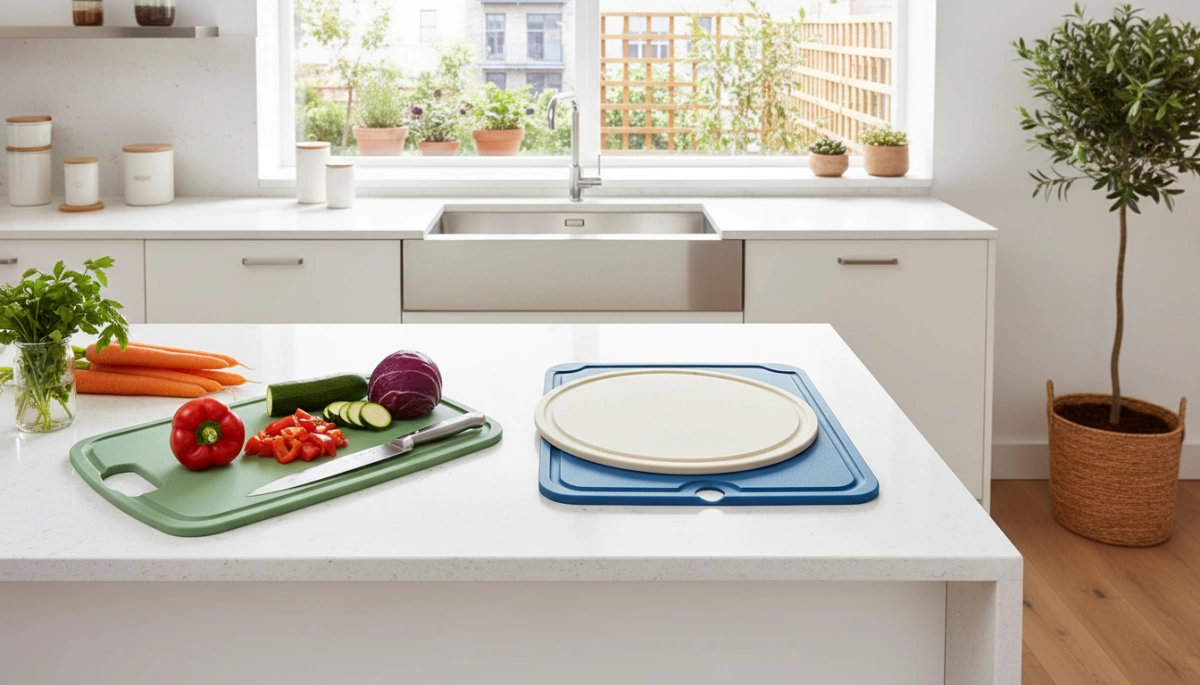
When we talk about turning waste into utility through sustainable plastic manufacturing, one question always comes up: Is a recycled board actually safe for food prep? The short answer is absolutely yes.
Debunking Contamination Myths
There is a common misconception that upcycled plastic materials carry over previous contaminants. In reality, the modern sanitization process for kitchen tools is incredibly rigorous. Through extreme high-temperature melting and intensive chemical washing, the resulting food-grade recycled plastic is structurally identical to—and often safer than—virgin plastic. You get non-toxic chopping surfaces without the environmental guilt.
Built-in Antimicrobial Protection
To push safety even further, we integrate advanced hygiene tech directly into our sustainable food prep surfaces.
- Active Defense: We utilize silver-ion technology and Microban protection during the molding process.
- Maximum Efficacy: This effectively eliminates 99.9% of surface bacteria, making it an ideal antibacterial chopping board for raw meats and fresh produce alike.
Regulatory Peace of Mind
We don’t just ask you to take our word for it. Reliable eco-friendly kitchenware must pass strict global health standards. When evaluating any recycled HDPE cutting board or bio-composite alternative, always look for the proof:
- FDA approved recycled plastic certifications.
- SGS testing reports confirming material purity and safety.
- 100% BPA-free guarantees.
Properly manufactured sustainable boards deliver complete peace of mind, ensuring your zero-waste kitchen products stay perfectly sanitary while keeping plastic out of our landfills.
How Calmchop Pioneers Sustainable Kitchen Innovation
As a leading Calmchop cutting board manufacturer, we don’t just talk about going green; we actively build it into our production lines. We are constantly turning waste into utility by designing zero-waste kitchen products that perform exceptionally well in real-world, high-volume environments.
The Wheat Straw Eco Advantage
We are pushing beyond standard recycled plastic manufacturing by integrating proprietary bio-composites into our materials. By utilizing agricultural byproducts like wheat straw, we drastically reduce our reliance on petroleum-based plastics. This creates highly durable, non-toxic chopping surfaces that are completely renewable. It is a major step forward in sustainable product design, giving you a tough, reliable board that actively reduces environmental impact.
Tech-Driven Durability
An eco-friendly board is only sustainable if you don’t have to replace it every few months. Inside our intelligent factory, we engineer our sustainable food prep surfaces to withstand heavy daily use.
- 10,000+ Cut Resistance: Our boards are rigorously tested to handle over 10,000 knife strikes without compromising surface integrity.
- Reduced Grooving: By keeping the surface smooth and intact, we eliminate the deep scratches where germs usually hide. This is why our designs frequently rank among the best antibacterial cutting boards available today.
- Material Strength: Even our standard PP cutting board variants utilize high-density processing to ensure maximum lifespan and minimal wear.
Zero-Waste Production
We manage the entire eco product lifecycle to ensure our footprint remains as small as possible. Our approach to sustainable plastic manufacturing is built on strict accountability and efficient resource loops.
- Closed-Loop Manufacturing: We recycle factory scraps directly back into the production line to eliminate excess plastic waste.
- Ethical Operations: Our facilities are fully BSCI-compliant, ensuring fair, safe, and ethical labor practices across our entire supply chain.
- Carbon-Neutral Shipping: We offset the emissions for our global deliveries, ensuring our custom kitchen solutions reach your door without adding to the global carbon burden.
Comparing Cutting Board Materials
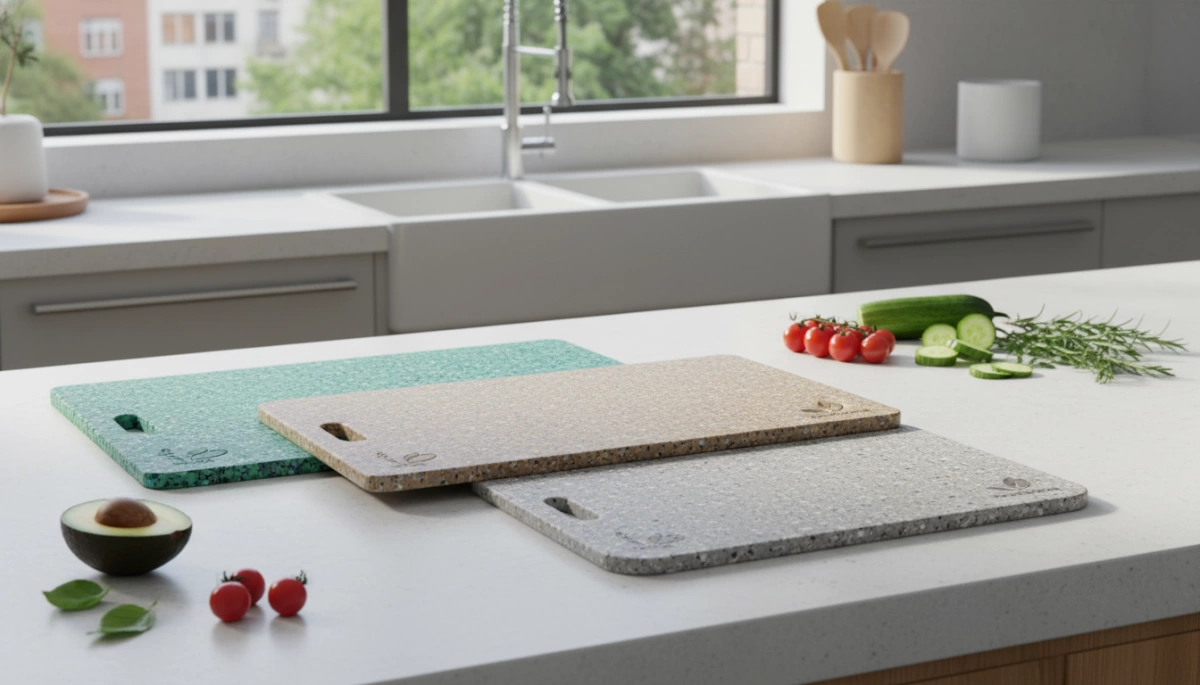
When choosing eco-friendly kitchenware, I always tell people to look at the whole picture. How a board is made, how it performs in your kitchen, and where it ends up all matter. I’ve broken down how traditional options compare to modern, sustainable food prep surfaces so you can make an informed choice.
Here is a quick look at how different materials stack up:
| Feature | Traditional Virgin Plastic | Upcycled/Recycled Plastic | Bio-Composites (e.g., Wheat Straw) |
|---|---|---|---|
| Environmental Impact | High carbon footprint | Low carbon footprint | Renewable, biodegradable elements |
| Bacterial Resistance | Low (bacteria hides in deep cuts) | Medium to High | High (Silver-ion tech integration) |
| Microplastic Shedding | High risk | Low to Medium risk | Extremely Low risk |
| End-of-Life Disposal | Landfill | Recyclable | Highly Sustainable |
The differences in everyday utility are clear. Traditional boards are notorious for shedding microplastics into food and letting bacteria hide in deep knife grooves. On the other hand, understanding PP cutting boards and sustainability proves that practical solutions for eco-aware consumers do exist. By shifting to bio-composites or food-grade recycled plastic, you get a much safer, non-toxic chopping surface that actively helps in reducing plastic waste without compromising on durability.
Maximizing the Lifespan of Your Sustainable Board
To get the most out of your eco-friendly kitchenware, routine care is non-negotiable. While we design our boards for ultimate durability, how you treat them at home determines their true eco product lifecycle.
Proper Care and Maintenance
Keep your sustainable food prep surfaces in top shape with these simple daily habits:
- Wash immediately: Clean with warm, soapy water right after slicing to prevent stains from setting.
- Sanitize naturally: A quick spray of white vinegar or a rub with half a lemon neutralizes odors without relying on harsh industrial chemicals.
- Dry upright: Always store your boards vertically. This allows them to air dry completely and prevents moisture buildup that can lead to warping.
- Leverage built-in tech: If you use our antimicrobial BPA-free plastic cutting boards, the integrated technology actively works to stop bacteria between washes, but routine cleaning ensures the protective surface remains fully effective.
Knowing When to Replace
Even the toughest zero-waste kitchen products eventually wear out. It is time to retire your cutting board when you notice:
- Deep knife grooves: Once scores become too deep to scrub clean, they turn into breeding grounds for bacteria.
- Warping: A board that spins, rocks, or won’t sit flat on the counter is a major slipping hazard.
- Stubborn smells: If odors linger long after a deep clean, the non-porous surface barrier has broken down.
Creative Upcycling Ideas
Before you throw that old board away, rethink its purpose. Reducing plastic waste means giving everyday items a second life. Here are a few ways we reuse retired boards around the house:
- Workshop protector: Keep it on your workbench to guard against paint spills, glue drips, or drill marks.
- Plant coaster: Slide it under heavy indoor planters to catch excess water and protect your hardwood floors.
- Crafting base: Use it as a dedicated, easy-to-clean mat for messy kids’ art projects or clay molding.
By repurposing upcycled plastic materials instead of tossing them, we keep functional utility out of the landfill and fully embrace a sustainable, circular mindset.
If you have interested in any cutting board, please feel free to contact sales@chopaid.com at any time
 English
  German
  Turkish
  Italian
  Russian
  Polish
  Arabic
  French
  Malay
Malay  Japanese
  Korean
  Thai
Thai