
Why Go Recycled? The Big Shift
As the team behind Calmchop cutting board manufacturer, we’ve witnessed a massive evolution in sustainable kitchenware trends. You want green kitchen products that actually perform. That’s exactly why the demand for recycled cutting boards is skyrocketing. We are finally moving away from the outdated “use and toss” mentality and fully embracing zero-waste kitchen products that look great and work hard on your counters.
The Circular Economy: Closing the Loop
We don’t just want to produce more items; we want to manufacture them smarter. The circular economy in manufacturing means taking what already exists and giving it a powerful new life.
- No More Landfills: We rescue high-quality, usable materials from entering the waste stream.
- Constant Rebirth: Everyday waste is transformed into durable, recycled plastic kitchenware.
- True Sustainability: Closing the loop ensures materials stay in active circulation, not buried in the ground.
Cutting Carbon Footprints in the Kitchen
Every prep tool in your house carries an environmental cost. By choosing recycled plastic cutting boards, you actively lower the carbon footprint of kitchenware in your home.
- Fewer Fossil Fuels: It takes significantly less energy to mold recycled materials than to extract and refine virgin plastics.
- Reduced Emissions: Smarter, localized manufacturing means less greenhouse gas output.
- Heavy-Duty Lifespan: Eco-friendly doesn’t mean fragile. These surfaces are built to withstand years of heavy daily chopping, keeping replacements to an absolute minimum.
Consumer Demand for Transparency
Today, you want to know exactly what is touching your food. We hear you loud and clear. The modern push for transparency and ethical supply chains is no longer optional. You aren’t just buying a kitchen tool; you’re investing in a safer, healthier home. Whether you are prepping a massive family dinner or searching for the perfect eco-friendly housewarming gifts, clear material sourcing isn’t a luxury—it is our baseline expectation.
Decoding Sustainable Materials
When building a zero-waste kitchen, the materials you prep your food on matter just as much as the food itself. As a manufacturer keeping pace with global sustainable kitchenware trends, we are seeing a massive shift toward innovative, earth-friendly materials that do not compromise on durability or safety.
Wheat Straw & Rice Husk: The Bio-Composite Rise
Agricultural by-products like wheat straw and rice husk used to be burned or treated as waste. Today, we are upcycling them into high-performance bio-composite cutting boards.
- Resource Recovery: Repurposes raw farming leftovers into functional tools.
- Wheat straw kitchenware benefits: You get a lightweight, durable surface that supports microplastic-free cooking.
- Everyday Toughness: These boards are naturally sturdy, non-toxic, and designed to handle daily slicing and dicing without easily degrading.
Recycled Bamboo & Wood Composites
Traditional wood boards require logging, but recycled bamboo and wood composites take a smarter route by relying on offcuts and fast-growing fibers.
- Maximized Resources: Compresses leftover wood fibers and bamboo scraps that would otherwise be discarded.
- Upgraded Durability: The manufacturing process creates ultra-dense, non-porous cutting surfaces. This means they resist warping, splintering, and moisture buildup much better than standard raw wood boards.
Recycled HDPE Explained
Plastics still have a major place in commercial and busy home kitchens, provided they are sourced and manufactured responsibly. By utilizing recycled high-density polyethylene (HDPE) and advanced high-density polyethylene (HDPE) alternatives, we keep existing plastics in the circular economy and out of the ocean.
- Heavy-Duty Performance: These recycled plastic cutting boards offer a commercial-grade, easy-to-clean surface that grips the counter but won’t dull your knives.
- Smart Kitchen Integration: Understanding how PP cutting boards fit into smart and sustainable kitchen concepts highlights the true value of using recyclable, BPA-free sustainable materials.
- Maximum Longevity: They are built to withstand high-heat dishwashers and aggressive chopping, ensuring a long lifecycle before they ever need to be recycled again.
Is Recycled Material Sanitary?
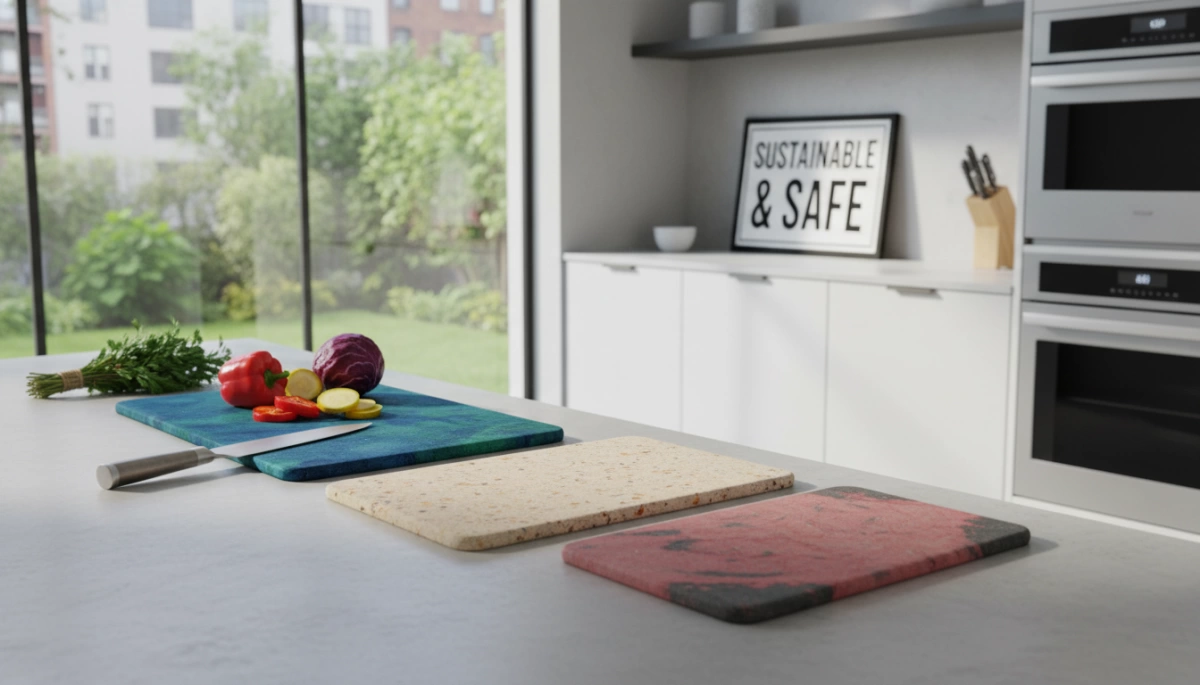
One of the most persistent concerns driving sustainable kitchenware trends is the fear that “recycled” implies “unclean.” However, modern manufacturing has completely bridged the gap between eco-friendliness and hygiene. At Calmchop, we view material safety as the foundation of our production, ensuring that a board made from wheat straw or recycled composites is just as safe—if not safer—than traditional virgin plastic or wood.
Silver-Ion Technology & Microban Protection
We don’t just mold materials; we engineer them for health. Our manufacturing process integrates advanced Silver-Ion and Microban technology directly into the raw material mix. This is not a temporary spray or coating that wears off after a few washes. Instead, it is an intrinsic property of the board that works 24/7 to disrupt the cell walls of bacteria.
Our internal and third-party lab testing confirms that this technology is 99.9% effective against common foodborne pathogens. This innovation allows us to offer recycled cutting boards that actively fight germs, providing a massive advantage over standard boards that can become breeding grounds for microbes. You can explore more about how this tech protects your family in our guide on the hidden benefits of antibacterial cutting boards.
FDA Certification & BPA-Free Labels
Sourcing sustainable materials requires rigorous oversight. We adhere to strict global standards to ensure that every eco-board we produce is 100% safe for food contact.
- FDA Compliance: All materials, including our wheat straw and bio-composites, are FDA-certified food grade.
- BPA-Free: We guarantee that our products are 100% free from Bisphenol A (BPA) and other harmful industrial chemicals.
- ISO 9001 Certified: Our “intelligent factory” operates under ISO quality management systems, ensuring traceability and consistency in every batch.
The Truth About Bacteria on Boards
The biggest hygiene threat in a kitchen is often the physical structure of the cutting surface. Soft, porous materials can develop deep knife scars where bacteria hide and multiply, out of reach of your sponge.
Our recycled and bio-composite boards are engineered to be high-density and non-porous. This design prevents meat juices and vegetable fluids from seeping into the core of the board. By combining a scratch-resistant surface with silver-ion technology, we ensure that bacteria have nowhere to hide and cannot survive on the surface, making these boards a superior choice for sanitary food prep.
Durability: The Real Sustainability
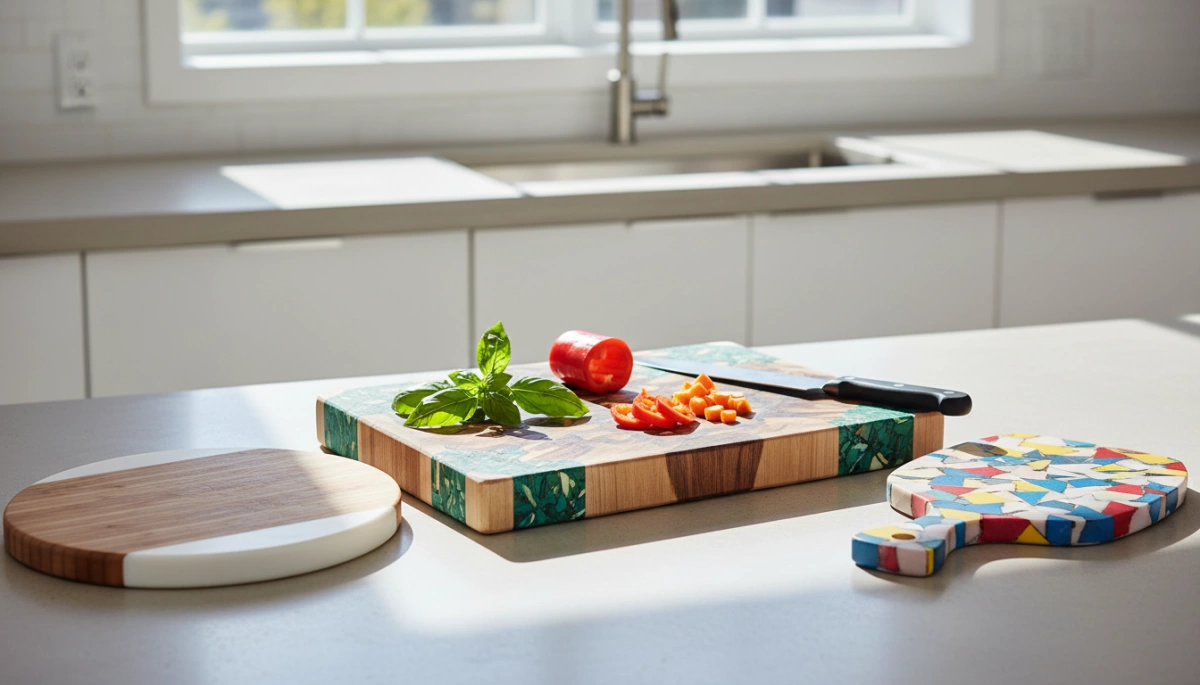
True sustainability means creating products that survive the daily grind. A zero-waste kitchen product isn’t actually zero-waste if it breaks down after a few months of use. In the current landscape of sustainable kitchenware trends, the growing demand for recycled cutting boards is directly tied to their long-term performance. We manufacture boards that are built to last, keeping them on your counter and out of the landfill.
Scratch Resistance & Bacteria Buildup
The biggest enemy of any food prep surface is deep knife scarring. Deep scratches capture food particles and create breeding grounds for dangerous microbes. We engineer our eco-friendly kitchen products to feature dense, non-porous cutting surfaces that actively resist heavy blade impacts. This keeps the board sanitary and dramatically extends its usable life. If you are comparing material lifespans, understanding how plastic and wooden chopping boards each have their own advantages and disadvantages is a great starting point for managing scratch resistance and hygiene.
Wear Testing Benchmarks
We do not guess how long our durable biodegradable kitchen tools will last. We put them through rigorous wear testing benchmarks to guarantee they meet the demands of a modern kitchen.
- Impact Resistance: Drop-tested on hard surfaces to ensure they will not crack or split.
- Blade Edge Retention: Tested to ensure the recycled plastic kitchenware does not prematurely dull your knives.
- Surface Stress Simulation: Subjected to heavy, repetitive slicing to verify long-term structural integrity.
Dishwasher Safety Factors
Nobody wants high-maintenance kitchen tools. For a cutting board to be truly practical, it must handle modern cleaning routines without failing.
- High Heat Tolerance: Engineered to survive repeated cycles in high-temperature residential and commercial dishwashers.
- Warp Resistance: Formulated to remain perfectly flat, ensuring a safe and stable chopping surface.
- Structural Integrity: Withstands harsh detergents without peeling, degrading, or releasing microplastics into the wash.
Sustainable Cutting Board Buying Guide
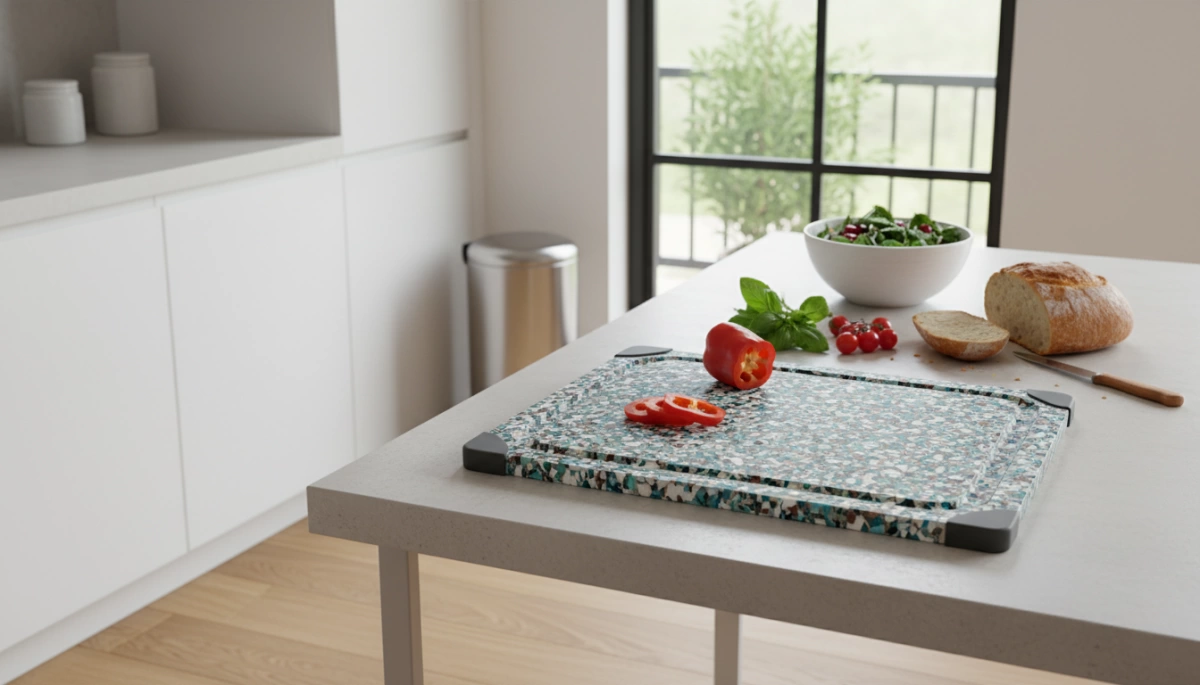
Upgrading to green kitchen products requires knowing exactly what to look for. As a Calmchop cutting board manufacturer, we track the sustainable kitchenware trends to ensure our products meet strict global standards. Here is how to evaluate and choose the best recycled plastic cutting boards for your daily meal prep.
Verifying Material Origin
It is crucial to know where your kitchen tools come from. Always verify if the manufacturer operates within an ethical supply chain (BSCI) and clearly lists their bio-composite or recycled sources. Understanding what makes a greener cutting board guarantees you are investing in genuine zero-waste kitchen products rather than greenwashed alternatives. Prioritize FDA certified recycled plastic and BPA-free sustainable materials for total peace of mind.
Checking for Antimicrobial Properties
Food safety cannot be compromised. Sustainable materials must also be highly hygienic. Look for non-porous cutting surfaces equipped with integrated silver-ion protection. Confirming silver-ion technology safety ensures your board actively prevents cross-contamination, providing reliable, antimicrobial food prep surfaces that keep your family safe.
Functional Design Features
A board must perform flawlessly to earn its spot on the counter. Beyond standard flat surfaces, practical innovations like deep juice grooves, non-slip TPR edges, and foldable designs that simplify meal prep add massive value to your cooking routine. Durable biodegradable kitchen tools should enhance functionality, not restrict it.
Recyclability at End-of-Life
Real sustainability means planning for the product’s entire lifecycle. When eco friendly kitchen products finally wear out, they should not end up in a landfill. Select recycled plastic kitchenware that can be easily remelted or commercially composted. This active participation directly supports the circular economy in manufacturing and lowers the overall carbon footprint of kitchenware.
Buyer’s Quick Checklist
| Feature | What to Look For | Why It Matters |
|---|---|---|
| Material Origin | BSCI certification, FDA approval | Ensures ethical sourcing and microplastic-free cooking. |
| Hygiene Standards | Silver-Ion technology, Non-porous | Naturally stops bacteria growth and stains. |
| Functional Design | Non-slip edges, Foldability | Makes cooking fast, efficient, and mess-free. |
| End-of-Life | 100% Recyclable or Compostable | Closes the loop and reduces environmental impact. |
Frequently Asked Questions on Sustainable Kitchenware Trends
Are wheat straw cutting boards dishwasher safe?
Yes, most are dishwasher safe. However, extreme heat cycles can slowly degrade bio-composite cutting boards over time. We recommend washing them by hand with warm water and mild soap. To maximize the longevity of your zero-waste kitchen products, following basic cutting board maintenance tips is the smartest approach.
How long do recycled cutting boards last?
A standard recycled plastic cutting board typically lasts between 1 to 5 years, depending on your daily prep volume. Once deep scratches form, it is time for a replacement to keep your kitchen sanitary. If you manage a larger operation, staying updated on 2026 plastic cutting board trends will help you know exactly when to upgrade for maximum safety and efficiency.
Do recycled plastic boards dull knives?
No, they do not. Materials like high-density polyethylene (HDPE) alternatives are actually designed to be gentle on blades. They offer a yielding, non-porous cutting surface that absorbs the strike of the knife, preventing the rapid dulling effect you get from glass, ceramic, or stone boards.
Is Silver-Ion technology safe for food contact?
Absolutely. Silver-Ion technology safety is well-established for culinary use. These treatments create a reliable antimicrobial food prep surface without leaching harmful chemicals into your meals. We always ensure our sustainable kitchenware meets strict FDA certified recycled plastic guidelines, providing a completely BPA-free sustainable material for safe, daily food preparation.
If you have interested in any products, please feel free to contact sales@chopaid.com at any time
 English
  German
  Turkish
  Italian
  Russian
  Polish
  Arabic
  French
  Malay
Malay  Japanese
  Korean
  Thai
Thai